
 Français
 Español
 Italiano
 Deutsch
 Português
 Русский
 Nederlands
 English
Contents
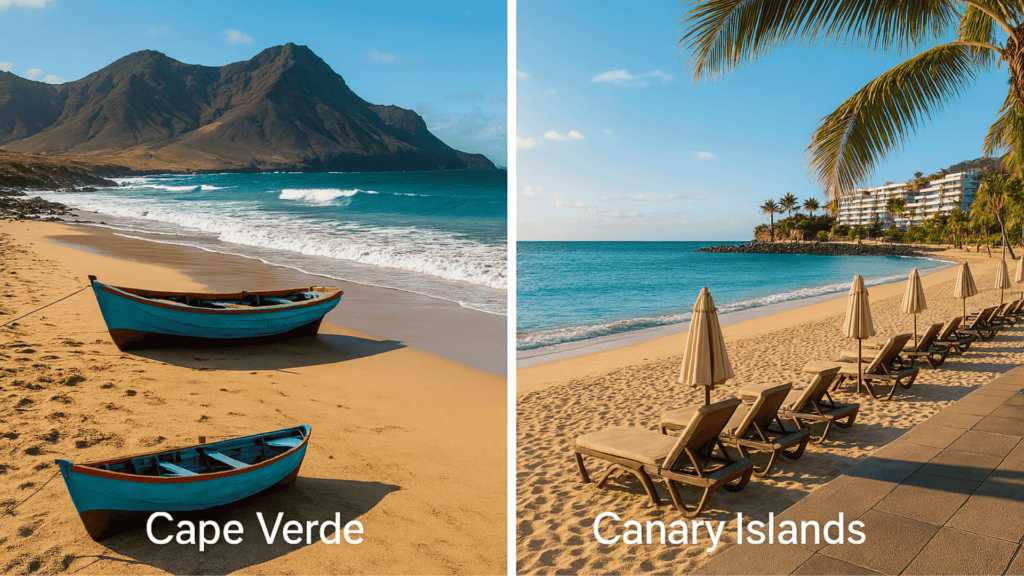
For a week of sunshine with no paperwork, especially with young children, the Canary Islands win. For warmth in the middle of winter, a culture that feels far from home, and a stay of ten days or more, Cape Verde is the better choice. Here are the figures that help you decide, month by month.
At a Glance
- Cape Verde is warmer all winter; the Canaries catch up from June and are almost as hot as Cape Verde in summer.
- Over the year, the Canaries get more sunshine hours than Sal and Praia.
- Rain falls from August to October in Cape Verde, and from November to March in the Canaries.
- The Canaries are simpler: shorter flight, no entry formalities, and services everywhere.
- Cape Verde requires online registration and a tax before departure, but no visa for stays of up to 30 days.
- Cape Verde receives far fewer visitors, and that is what gives it its character.
Planning a trip to Cape Verde?
Tell us about your project: we will connect you with a local agency that knows every island and will prepare a proposal tailored to your wishes and your budget.

Climate: Where Is It Warmest, and When?
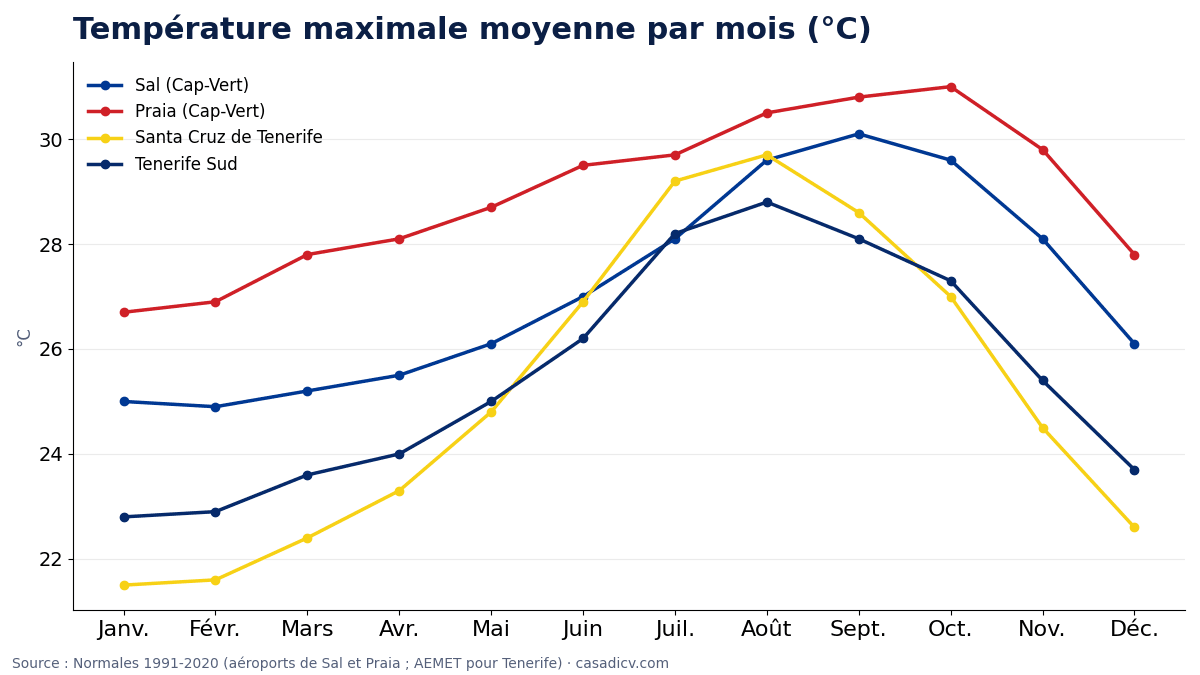
Both archipelagos are shaped by the trade winds, but they lie at different latitudes, and this shows as early as winter. In January, the average maximum temperature reaches 25.0 °C on Sal and 26.7 °C in Praia, on the island of Santiago. It drops to 22.8 °C in Tenerife South and 21.5 °C in Santa Cruz de Tenerife. These figures are 1991-2020 normals, and they tell a simple story: if you want to wear your swimsuit in January, Cape Verde is the safer bet. On Sal, the sea never drops below 22 °C, its February minimum.
| Month (1991-2020 normals) | Sal, Cape Verde: maximum, rain, sunshine | Tenerife South, Canary Islands: maximum, rain, sunshine |
|---|---|---|
| January | 25.0 °C · 2.8 mm · 183 h | 22.8 °C · 16.5 mm · 222 h |
| March | 25.2 °C · 0.5 mm · 202 h | 23.6 °C · 12.6 mm · 257 h |
| June | 27.0 °C · 0.0 mm · 174 h | 26.2 °C · 0.3 mm · 284 h |
| August | 29.6 °C · 12.8 mm · 161 h | 28.8 °C · 1.5 mm · 311 h |
| September | 30.1 °C · 34.5 mm · 180 h | 28.1 °C · 3.0 mm · 248 h |
| November | 28.1 °C · 1.3 mm · 189 h | 25.4 °C · 10.9 mm · 212 h |
| December | 26.1 °C · 3.4 mm · 155 h | 23.7 °C · 33.3 mm · 215 h |
| Year | 27.1 °C · 75.3 mm · 2,187 h | 25.5 °C · 118.9 mm · 3,055 h |
The surprise comes from the sunshine. Over the year, Tenerife South records 3,055 hours and Santa Cruz 2,999, ahead of Praia (2,926) and well ahead of Sal. In the Canaries, summer is distinctly dry and bright, with 346 hours of sunshine in July in Santa Cruz. In Cape Verde, the sunniest months run from March to May.
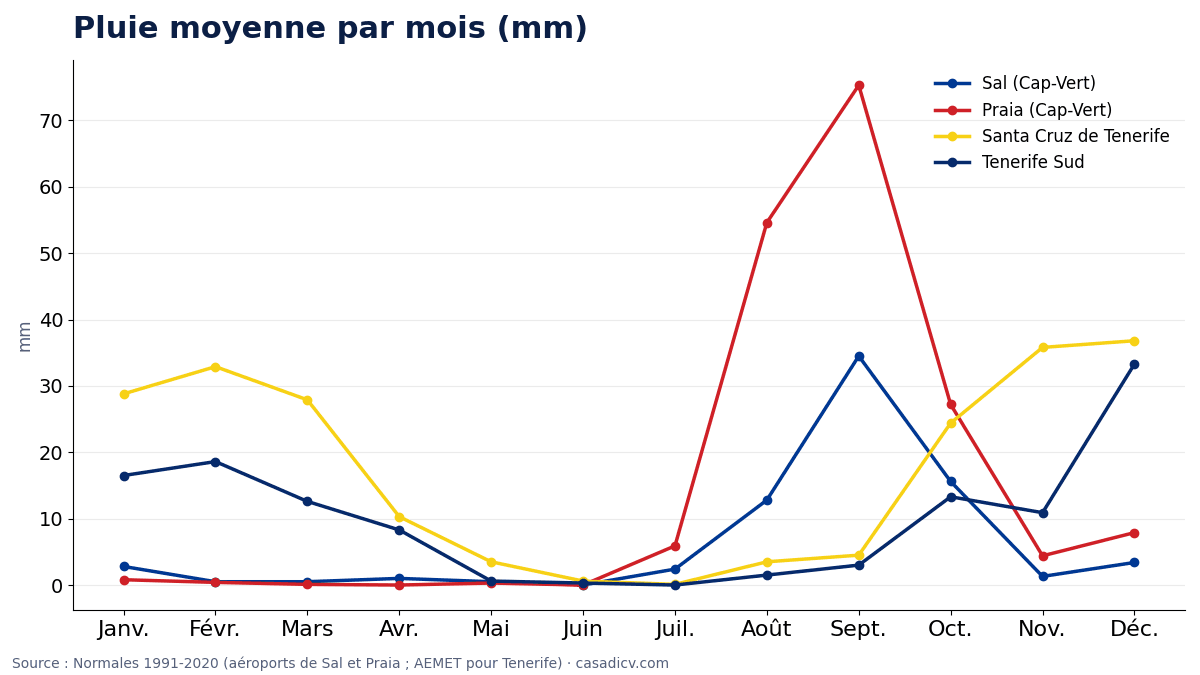
If you dislike heavy heat and downpours, the months to avoid in Cape Verde are August, September and October. In Praia, these three months receive 157 mm of rain out of the year’s 177 mm, including 75.3 mm in September alone. Sal is much drier, with 2.7 rainy days in September, which is why beach holidays there remain possible all year round. In November, a month often compared, Sal stays at 28 °C with almost no rain, while Santa Cruz has five rainy days.
In the Canaries, the calendar is reversed: the rains arrive from November to March, mostly in the north of Tenerife, and the south stays drier. On Fuerteventura, also be prepared for the calima, the Saharan dust wind that can add around ten degrees and reduce visibility to about a hundred metres. To pin down your dates island by island, our guide to when to travel to Cape Verde covers each season in detail, and you can also submit your dates to our partner agency, which knows the microclimate of each island.
Access and Formalities: What Really Changes
The Canary Islands lie about a hundred kilometres off the African coast; Cape Verde is roughly 570 kilometres away. Between the two archipelagos lies more than a thousand kilometres of ocean, so you choose one or the other rather than linking them in a single trip. The difference comes down mainly to flight time and the paperwork before departure.

| Criterion | Cape Verde | Canary Islands |
|---|---|---|
| Formalities for a French citizen | No visa for up to 30 days, mandatory EASE online registration | No particular procedure |
| Entry tax (November 2026) | TSA of CVE 3,400 online, about €31, or CVE 6,800 at the airport desk, about €62 | None |
| Flight from France | About 6 hours | About 4 hours |
| Between islands | Plane with CVsky, the state airline, or ferry | Binter, which serves all 8 airports |
| Visitor numbers in 2025 | 1.25 million hotel guests, 4.8 nights on average | 15.69 million foreign tourists |
In practice, before travelling to Cape Verde, you complete the EASE form online and pay the TSA; paying at the desk on arrival costs double (conversion at 1 EUR = 110.265 CVE). Nothing complicated, but it is a step the Canaries do not ask of you. The details are in our page on the visa for Cape Verde, and the one on airports and flights to the archipelago details the air connections within the archipelago. Finally, note the size effect the table shows: Cape Verde receives a small fraction of the Canaries’ visitors, which means less crowded beaches, but also less choice at every level.
Beaches, Hiking, Culture: Where Each Archipelago Excels
When it comes to beaches, both archipelagos are well served. Boa Vista, a desert island of more than 630 km², has placed 37% of its territory under protection and welcomes loggerhead turtles on its beaches. Fuerteventura has 152 beaches along 77 kilometres of sand and pebbles, including about fifty kilometres of white sand, the longest stretches of this kind in the Canaries. The wind is steady there: a windsurfing and kitesurfing championship has been held on the beaches of Sotavento since 1985. Sal and Boa Vista offer the same type of windy waters on the Cape Verdean side.

For hiking, Santo Antão is hard to beat: the island peaks at 1,979 metres, with deep valleys where trekking makes up most of the tourism. The Canaries answer with variety: humid laurel forests in central Tenerife, La Gomera and La Palma, volcanoes, cliffs. They are also better equipped, with waymarked trails, accommodation at every price and services within easy reach. This is a real advantage if you are travelling with several generations.

Culture is where Cape Verde takes the lead. Its Creole culture blends African and Portuguese influences, with music everywhere, from funaná to morna. The Spanish of the Canaries does not feel as foreign to a European traveller. If you are looking for the island that suits your tastes, our comparison on choosing your island in Cape Verde will save you time, and the partner agency can put together a tailor-made multi-island itinerary.
Which Archipelago Suits Your Trip
A week with young children
The Canaries: shorter flight, water parks, equipped beaches, services everywhere. Tenerife South, Gran Canaria or Lanzarote are all suitable. Cape Verde remains possible with a resort on Sal, and our page on Cape Verde with the family explains how to go about it; however, getting between islands is less straightforward.
Hikers and nature lovers
Santo Antão for valleys and ridges, Tenerife or La Palma for waymarked trails and forests. The Canaries are easier, Cape Verde is wilder.
Kitesurfing and windsurfing
Fuerteventura for its infrastructure and competition tradition, Sal or Boa Vista for windy waters in a wilder setting.
Winter warmth and a change of scenery, ten days or more
Cape Verde, with Sal or Boa Vista for the beach and Santiago or Santo Antão for discovery. From about ten days onward, flight time matters less, and the itinerary is worth the effort. For a specific budget and itinerary, you can ask the local agency for a proposal tailored to your budget.
Frequently Asked Questions
What is the most interesting island in the Canaries?
It depends on what you are looking for. Tenerife combines laurel forests, volcanoes and varied trails, while Fuerteventura offers 152 beaches and constant wind for kitesurfing. Choose Tenerife for variety, Fuerteventura for the sea.
Which months should you avoid in Cape Verde?
August, September and October, if you want to avoid heavy heat and downpours: in Praia, these three months receive 157 mm of the year’s 177 mm of rain. Sal remains much drier, and beach holidays there are possible all year round.
How far apart are the Canary Islands and Cape Verde?
More than a thousand kilometres of ocean separate the two archipelagos. The Canaries are about a hundred kilometres off the African coast, Cape Verde about 570 kilometres: you choose one or the other rather than linking them in a single trip.
Are the Canary Islands really tropical in winter?
Not quite: in January, the average temperature in Santa Cruz de Tenerife is 18.5 °C, compared with 22.0 °C on Sal. For days in a swimsuit, Cape Verde is safer; for days of walking in a T-shirt, the Canaries are enough.
Is Cape Verde suitable for a first trip outside Europe?
Yes, provided you plan ahead for the EASE registration and the TSA. Portuguese is the official language, Creole is the everyday language, and the escudo is pegged to the euro, which makes budgeting simpler. A local agency can arrange transfers and flights between islands.
Sources
- Sal (Cape Verde): 1991-2020 climate data (accessed 2026-11)
- Praia: 1991-2020 climate data (accessed 2026-11)
- Tenerife: AEMET climate data 1991-2020 (accessed 2026-11)
- Canary Islands: geography, climate, population (accessed 2026-11)
- Cape Verde: geography, population, currency (accessed 2026-11)
- Boa Vista: geography, tourism, protected areas (accessed 2026-11)
- Santo Antão: relief and hiking (accessed 2026-11)
- Fuerteventura: beaches, wind, climate (accessed 2026-11)
- Binter Canarias: inter-island connections (accessed 2026-11)
- French Ministry of Foreign Affairs: travel advice for Cape Verde (accessed 2026-11)
- French Ministry of Foreign Affairs: Cape Verde country page (accessed 2026-11)
- RTVC: 15.69 million foreign tourists in the Canary Islands in 2025 (accessed 2026-11)
- Forbes Africa Lusófona: tourism in Cape Verde in 2025 (INE data) (accessed 2026-11)
Are you planning a trip to Cape Verde?
To organize your stay, we work with a local agency based in Cape Verde, which knows the archipelago island by island. Tailor-made tours, accommodation, inter-island flights, excursions: describe your project, we put you in touch and the agency prepares a proposal tailored to your wishes and budget.

Written by Adilson Gomes Garcia
Founder of Casa di CV and Gomia-Voyage, I was born in Santiago and I am committed to showcasing African territories, starting with Cape Verde. Through my platforms, I help travelers and curious minds better understand these destinations, their cultures and their realities, so they can plan authentic and respectful trips. My goal: to offer a clear, local and useful perspective for discovering Africa as it really is, with its riches and its identity.