
 Français
 Español
 Italiano
 Deutsch
 Português
 Русский
 Nederlands
 English
Contents
- At a glance
- How many Catholics, Protestants and people with no religion?
- Where this faith comes from: from Cidade Velha to today’s dioceses
- A secular state, but a special link with the Catholic Church
- Religious festivals and public holidays in 2027
- São João, Tabanka and the music of the processions
- Visiting a church or a festival: good manners
- Which island for which religious atmosphere?
- Frequently asked questions
- Sources
Cape Verde is a Christian country, overwhelmingly Catholic, where people practise their faith without the state imposing any religion: freedom of worship is written into the Constitution and no significant religious tension has been reported. For a traveller, this means churches that are open to visitors, saints’ feast days that mark the year, and a tolerance that makes visits easy, whatever your own beliefs.
At a glance
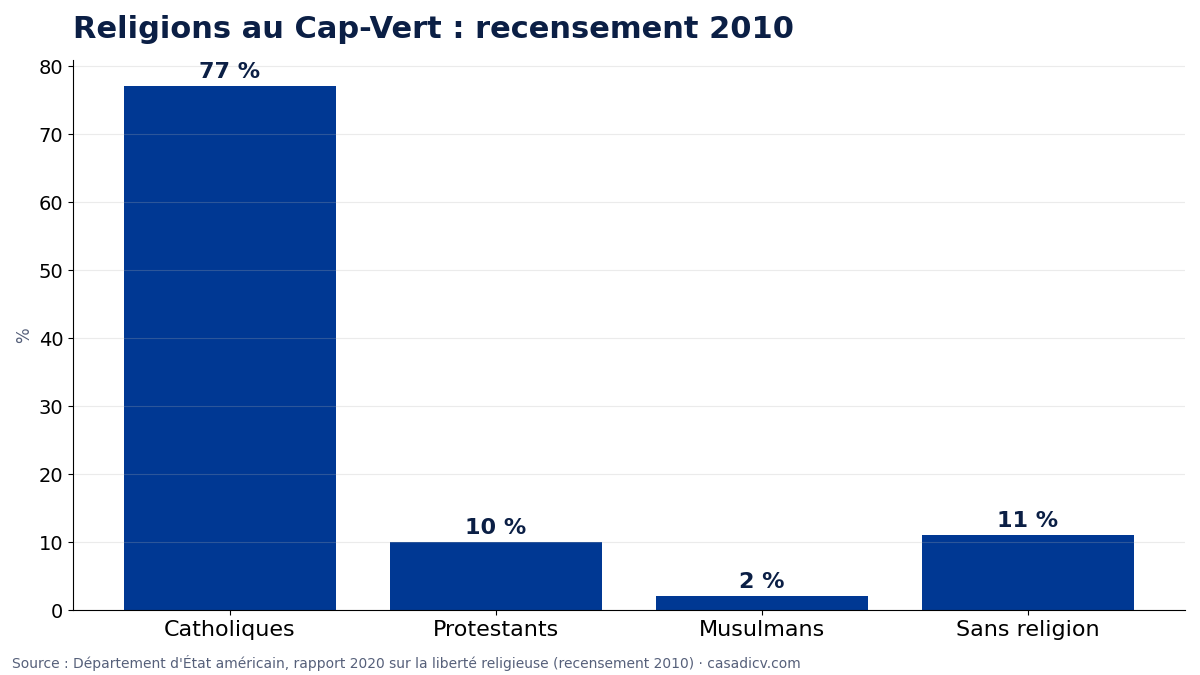
- 2010 census: 77% Catholic, 10% Protestant, 2% Muslim and 11% with no religion. 2021 census: 73% Catholic and 16% with no religion.
- After Catholics, the main Christian churches are the Church of the Nazarene and the Seventh-day Adventists, followed by the Assemblies of God and independent Baptists.
- The state is secular: the Constitution separates religion and state, and undermining freedom of religion is a crime punishable by 3 months to 3 years in prison.
- A concordat with the Holy See gives the Catholic Church a special status, including several Catholic feasts as public holidays.
- In 2027, Easter falls on Sunday 28 March, Good Friday (public holiday) on 26 March, and the Assumption on Sunday 15 August.
- The church of Nossa Senhora do Rosário (1495), considered the oldest colonial church in the world, can be visited in Cidade Velha, on Santiago.
Planning a trip to Cape Verde?
Tell us about your project: we will put you in touch with a local agency that knows every island and will prepare a proposal tailored to your wishes and budget.
How many Catholics, Protestants and people with no religion?
Figures vary from one source to another, because surveys do not ask the question in the same way and censuses date quickly. The 2010 census remains the most detailed; the 2021 census, which counted 491,233 residents, shows a decline in Catholicism and a clear rise in people with no religion.
| Source | Christians | No religion |
|---|---|---|
| 2010 census | 77% Catholic, 10% Protestant | 11% |
| 2021 census | 73% Catholic, some churches at 2% | 16% |
| Pew, 2020 | 78.3% | 20.6% |
| WRD, 2020 | over 94% | under 1% |
Pew: Pew Research Center, 2020 estimate published in 2025. WRD: World Religion Database, a global database on religions.
The gap between 94% Christians and 78% is not a mistake: the first database counts the baptised, while the second counts those who declare themselves believers. It is better to remember the trend shown by the two censuses: a strong Christian majority, Catholicism dominant, and a growing share of people with no religion.
Among Protestants, the Church of the Nazarene is one of the most established. The Adventists, the Assemblies of God, the Universal Church of the Kingdom of God, independent Baptists, Mormons and various Pentecostal communities complete the picture. As a visitor, you will notice it mostly on Sunday mornings, in the neighbourhoods of Praia or Mindelo, through the songs coming from small chapels. If you would like to attend a Protestant service, ask the local agency to recommend a community that welcomes visitors.
Minorities are discreet. Muslims, around 1 to 2% of the population, are mostly traders who came from Senegal and West Africa. Bahá’ís form a small community. For Jews, sources disagree: the history begins in the 16th century with families fleeing the Portuguese Inquisition, and the American report still mentions a small community, while other works estimate that none remain today.

Where this faith comes from: from Cidade Velha to today’s dioceses
The archipelago was uninhabited when the Portuguese arrived. Christianity therefore came with settlement, starting in 1462, when Ribeira Grande, today Cidade Velha, was founded on the south coast of Santiago. The Diocese of Santiago de Cabo Verde was established there on 31 January 1533 by Pope Clement VII.
The site can still be visited. The church of Nossa Senhora do Rosário, built in 1495, is considered the oldest colonial church in the world, with a side chapel in Manueline Gothic style. A little further on, the ruins of the cathedral, begun in 1556 and completed in 1705, were looted by corsairs in 1712. The site has been a UNESCO World Heritage Site since 2009. To place all of this in the wider history of the archipelago and the Cape Verdean people, our page history of Cape Verde and traditions of the Cape Verdean people tells the rest of the story.
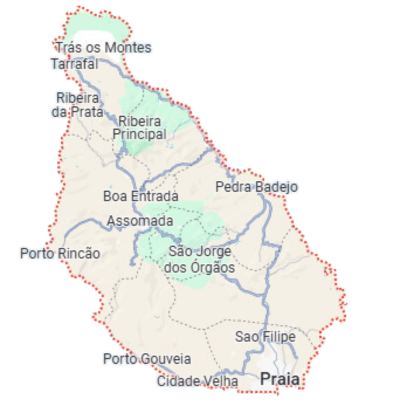
The seat of the diocese later moved: Ribeira Brava, on São Nicolau, from 1786 to 1943, then Praia, where the pro-cathedral Nossa Senhora da Graça is the centre. Since November 2003, the northern islands form a separate diocese, that of Mindelo. Two dioceses for ten islands: the diocesan map is therefore simple, Sotavento (Maio, Santiago, Fogo, Brava) on one side, Barlavento on the other.
A secular state, but a special link with the Catholic Church
The Constitution declares freedom of conscience, religion and worship inviolable, separates religion and state, and forbids the state from imposing any belief. In practice, you risk nothing by not practising, by changing religion, or by practising something other than Catholicism. Attacks on this freedom, such as discrimination or threats against a place of worship, are punishable by 3 months to 3 years in prison under the Penal Code of 2004.
Catholicism nevertheless holds a special place thanks to a concordat with the Holy See. The state recognises Catholic religious marriages as civil marriages, exempts from tax the Church’s income used for religious or non-profit activities, and makes several Catholic feasts public holidays. In some public schools, an optional course in religious and moral education, prepared by the Church, is offered.
Other groups face less flexible rules: to be officially recognised, a religious group must have 500 members and file its statutes with the Ministry of Justice. Not doing so does not prevent anyone from praying, but it means losing the tax exemptions and certain procedures, such as buying land or building a place of worship.
Religious festivals and public holidays in 2027
What strikes the traveller is less the doctrine than the calendar: each patron saint has a feast, with Mass, procession, then concerts and dancing. Here are the exact dates for 2027: those of the liturgical calendar of Cape Verde and those of the national public holidays.
| Date in 2027 | Day | Feast or public holiday |
|---|---|---|
| 1 January | Friday | New Year’s Day (public holiday) |
| 13 January | Wednesday | Democracy Day (public holiday) |
| 20 January | Wednesday | Day of the National Heroes (public holiday) |
| 9 February | Tuesday | Shrove Tuesday, Carnival (public holiday) |
| 10 February | Wednesday | Ash Wednesday |
| 26 March | Friday | Good Friday (public holiday) |
| 28 March | Sunday | Easter |
| 1 May | Saturday | Labour Day (public holiday) |
| 16 May | Sunday | Pentecost |
| 1 June | Tuesday | Children’s Day (public holiday) |
| 24 June | Thursday | Saint John the Baptist (solemnity, Feast of São João) |
| 5 July | Monday | Independence Day (public holiday) |
| 15 August | Sunday | Assumption (public holiday) |
| 1 November | Monday | All Saints’ Day (public holiday) |
| 8 December | Wednesday | Immaculate Conception |
| 25 December | Saturday | Christmas (public holiday) |
This calendar has concrete consequences. The Easter long weekend, from Friday 26 to Sunday 28 March, is a peak time for churches, and inter-island transport fills up quickly: book early. The 5 July and 1 November, both Mondays, also create three-day weekends. Conversely, 1 May, 15 August and 25 December fall on a weekend, so do not count on an extra day off to shift a journey. If you are unsure about the period, our page on the best times to travel to Cape Verde compares weather and events.
Would you rather see a saint’s feast than just hear about it? Ask the local agency to schedule your stay around the festival of a specific island.
São João, Tabanka and the music of the processions
Cape Verde’s religious calendar is experienced mostly in the street. Kola San Jon, the feast of Saint John the Baptist, runs from 3 May to 29 June and peaks on 24 June, a Thursday in 2027; it is celebrated on Santo Antão (notably in Porto Novo), São Vicente and São Nicolau. The procession mixes drums, songs and dancing, and combines African and European traditions. An oral tradition tells that John the Baptist, withdrawn to a hermitage, is brought back in procession by the inhabitants, who set off on 23 June and return on 25 June.
Tabanka has a more turbulent history. This music and these processions, born on Santiago and very popular on Maio, where the festivities begin on 3 May and continue until July, were opposed by the colonial administration as well as by the Church; Governor Serpa Pinto even banned them in Praia in 1896. The ban only ended with independence, and tabanka became a symbol of the struggle for identity. Other popular rhythms, funaná and batuque included, are covered in our page on funaná, Cape Verde’s traditional dance and music.

Visiting a church or a festival: good manners
Masses and processions are open to everyone, and locals willingly welcome a discreet visitor. A few simple gestures are enough: dress that covers shoulders and knees to enter a church, phone on silent during the service, and a polite request before photographing worshippers or children. During a procession, stand at the side rather than in the middle of the parade.
Saints’ festivals are also loud evenings that draw large crowds. For safety on these occasions, our page tourism, dangers and tips for travelling with peace of mind covers the right habits. For a festival trip, pack light clothing for the day and a warm layer for the evening; the packing list for Cape Verde details the rest.
Which island for which religious atmosphere?

- Santiago: Cidade Velha, its churches and its historic diocese, then Praia and its pro-cathedral; it is the island richest in religious heritage.
- Santo Antão and São Vicente: Kola San Jon around 24 June, with Porto Novo as the centre.
- Maio: tabanka processions from 3 May.
- São Nicolau: former seat of the diocese from 1786 to 1943 and a place where São João is celebrated.
To compare these islands on criteria other than faith, see how to choose your island according to your expectations. And if your trip revolves around a festival, describe your project to the local agency so they can build the itinerary around the date.
Frequently asked questions
What is the nationality of people from Cape Verde?
They are called Cape Verdeans (or Cabo Verdeans), feminine Cape Verdean. Everyday language is Cape Verdean Creole, while Portuguese remains the official language for documents and school.
Can I attend a Mass if I am not religious?
Yes, services are public. Enter quietly, stay at the back, keep your phone on silent, and do not photograph worshippers without their permission.
Are there mosques or non-Christian places of worship?
They exist but remain rare and discreet, since non-Christian communities are small: Muslims mainly live in the towns where West African traders are concentrated, and Bahá’ís form a small group. The 2020 American report notes no significant social action against freedom of religion.
Should I expect strict religious rules while travelling?
No. The state is secular and no religious rules apply to visitors. A respectful outfit in churches and a little quiet during services and processions is all that is needed.
Sources
- U.S. Department of State, Cabo Verde 2020 International Religious Freedom Report (accessed 2026-11)
- Wikipedia, Religion in Cape Verde (Pew 2020, 2021 census, ARDA) (accessed 2026-11)
- Wikipedia, Freedom of religion in Cape Verde (accessed 2026-11)
- Wikipedia, Islam in Cape Verde (accessed 2026-11)
- Wikipedia, Cap-Vert (Religion section) (accessed 2026-11)
- Wikipedia, Cidade Velha (accessed 2026-11)
- Wikipedia, Roman Catholic Diocese of Santiago de Cabo Verde (accessed 2026-11)
- Wikipedia, Kola San Jon (accessed 2026-11)
- Wikipedia, Tabanka (accessed 2026-11)
- Wikipedia, Public holidays in Cape Verde (accessed 2026-11)
- timeanddate, Cape Verde public holidays 2027 (accessed 2026-11)
- Tallyfy, Cape Verde national holidays 2027 (accessed 2026-11)
- GCatholic, Liturgical calendar Cabo Verde 2027 (accessed 2026-11)
- RTP/Lusa, INE: Cabo Verde had 491,233 residents in 2021 (accessed 2026-11)
- Lonely Planet, Cape Verde (accessed 2026-11)
Are you planning a trip to Cape Verde?
To organize your stay, we work with a local agency based in Cape Verde, which knows the archipelago island by island. Tailor-made tours, accommodation, inter-island flights, excursions: describe your project, we put you in touch and the agency prepares a proposal tailored to your wishes and budget.

Written by Adilson Gomes Garcia
Founder of Casa di CV and Gomia-Voyage, I was born in Santiago and I am committed to showcasing African territories, starting with Cape Verde. Through my platforms, I help travelers and curious minds better understand these destinations, their cultures and their realities, so they can plan authentic and respectful trips. My goal: to offer a clear, local and useful perspective for discovering Africa as it really is, with its riches and its identity.