 Français
 Español
 Italiano
 Deutsch
 Português
 Русский
 Nederlands
 English
Contents
In Cape Verde, two languages coexist: Portuguese, the official language, and Cape Verdean Creole, the language of the street, the home and the music. You don’t need to speak either one to travel there, but a few words of Creole change the welcome you receive.
In brief
- Portuguese is the only official language: Article 9 of the Constitution (2010 version) says so in a single sentence.
- The same article tasks the State with creating the conditions for Cape Verdean, the mother tongue, to become official on an equal footing with Portuguese, but no date has been set and it has not happened yet.
- Creole (kriolu, crioulo) is the mother tongue of almost the entire population: about 871,000 native speakers according to a 2017 estimate.
- There are two main families of Creole, that of the southern islands (Sotavento) and that of the northern islands (Barlavento), and each island has its own way of speaking.
- The official spelling, ALUPEC, has existed since 2009, but its use is not mandatory: the same sentence can therefore be written in several ways.
- French has been compulsory in secondary school since 1995: many Cape Verdeans who went through school retain some basics.
- Residents call themselves Cape Verdeans (feminine: Cape Verdean women).
Planning a trip to Cape Verde?
Tell us about your project: we will connect you with a local agency that knows every island and will prepare a proposal tailored to your wishes and budget.
Portuguese and Creole: who speaks what
Portuguese is the language of administration, justice, school and the written media. It is also the language of the former colonial power, which governed the archipelago until independence in 1975. To understand how things came to this point, see our page on the history of Cape Verde and its people.
Creole emerged between the late 15th and early 16th centuries from contact between Portuguese settlers and West Africans enslaved there. It became the means of communication for all islanders, and later travelled with Cape Verdean traders along the West African coast. Today, children learn it first at home, and Portuguese comes later at school; many Cape Verdeans do not speak Portuguese fluently. Political campaigns and church collections are often conducted in Creole, and morna, sung in Creole, has been inscribed on UNESCO’s Intangible Cultural Heritage list since 2019. If this music appeals to you, also read our pages on Cesária Évora and on funaná.
In practical terms: in official procedures, on signs and in documents, you will come across Portuguese; in everyday conversation, it’s Creole.
Will Creole become official?
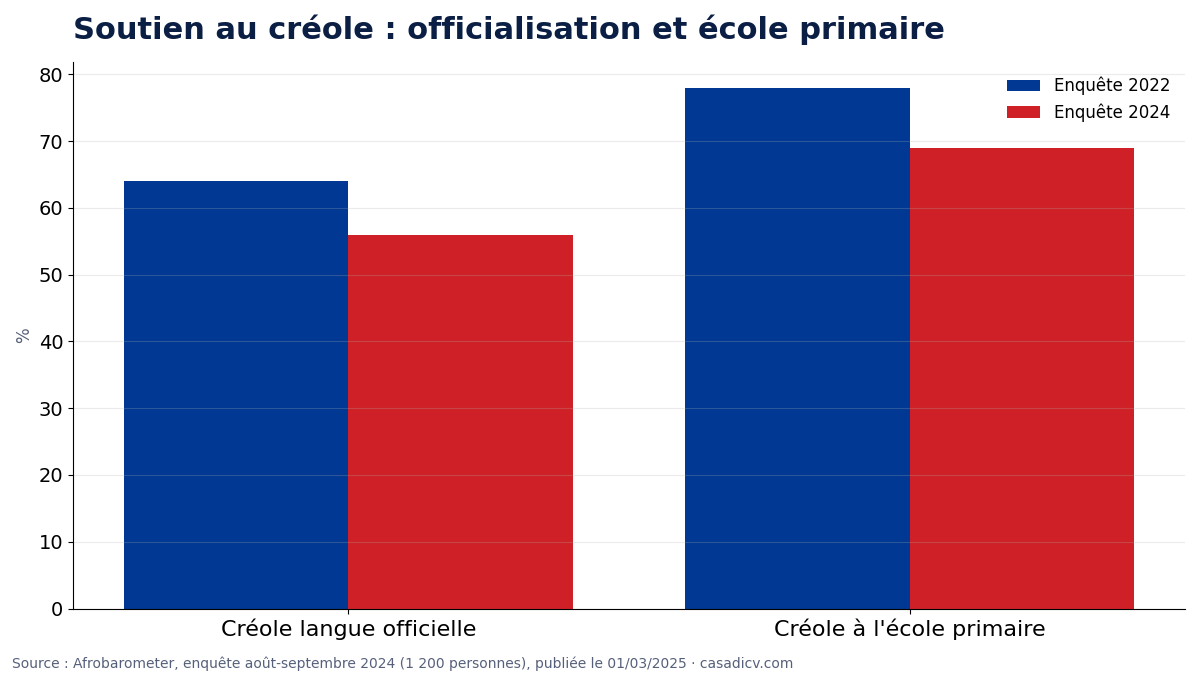
The principle is written into the Constitution, but nothing obliges the State to set a date. The difficulty lies largely in schools, textbooks and the standardisation of writing, since each island is attached to its own way of speaking. Public opinion is rather favourable, with a slight recent decline, as the chart below shows.
Sotavento and Barlavento: Creole changes with the island
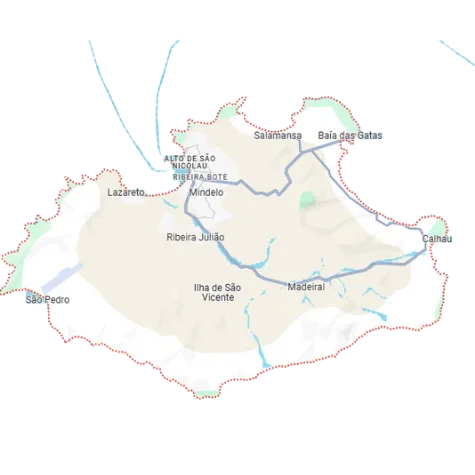
Southern Creole is spoken on Santiago, Fogo, Maio and Brava; northern Creole on Santo Antão, São Vicente, São Nicolau, Sal and Boa Vista. One example is enough to hear the difference: to say “you” in the plural, the south uses nhos, the north uses bzote. In between, the accent, some words and sometimes the grammar vary, and specialists note that the island dialects are converging, partly because many people move to Santiago for work.

| Family | Islands | Where to hear it |
|---|---|---|
| Sotavento (South) | Santiago, Fogo, Maio, Brava | Praia, Fogo |
| Barlavento (North) | Sal, Boa Vista, São Vicente, Santo Antão, São Nicolau | Sal, Boa Vista, Mindelo |

If you’re unsure which island suits you, our page Which island to choose based on your expectations will help you decide before you think about language.
Making yourself understood while travelling
On tourist circuits and in hotels, you will rarely need to speak Creole. As for French and English, no recent figures tell us how many people speak them; what we know is that French has been compulsory in secondary school since 1995, and that in the early 2000s roughly half of seventh-grade pupils chose it over English, which is also taught. Among generations who went through school, some basics therefore remain.
The simplest approach is to prepare your key phrases in Portuguese or Creole, and to let your agency organise the moments when language really matters: our guide to organising your trip details the steps, and you can also ask the local partner agency your language questions before booking.
17 useful phrases in Creole
The spelling is not fixed, and published lists don’t always specify which island each phrase comes from. The spellings below are those we found in several phrase guides; expect to see them written differently, and to hear variations from one island to another.
Greetings and introductions
| English | Creole | Note |
|---|---|---|
| Hello | Bon dia | Close to Portuguese |
| Good afternoon | Bon tarde | |
| Good evening | Bon noite | |
| How are you? | Kuma ku bu sta? | Other form: Komo bu staba? |
| Everything good? | Tud dret? | Informal |
| I’m fine, thank you | Sta bom, obrigado | |
| What’s your name? | Kuma ku bu nome? | |
| My name is… | Nha nome i… |
Politeness and getting by
| English | Creole | Note |
|---|---|---|
| Thank you | Obrigadu | Also written obrigado |
| Please | Di fabur | |
| Sorry, excuse me | Diskulpa | |
| Goodbye | Tchau | |
| I don’t understand | N’ka intindi | Other form: N ka ta komprende |
| I don’t speak Creole well | N’ka ta papia kriol bem | |
| Do you speak English? | Bu ta papia inglés? | |
| How much does it cost? | Es i kantu? | |
| Help! | Djuda-m! | Portuguese: Socorro! |
When in doubt, Portuguese works almost everywhere: “bom dia”, “obrigado”, “quanto custa?” (how much does it cost?) and “a conta, por favor” (the bill, please) will be understood. If you plan to stay connected to translate on the go, see also the best eSIMs for Cape Verde.
For further reading, the most comprehensive dictionaries are the work of researchers: a Creole-English dictionary of more than 40,000 words took its author ten years, and universities such as Freiburg im Breisgau, Lisbon and Orléans have published grammars, notably of the Santiago variety. To plan a stay where language matters, request a tailor-made itinerary from the local agency.
Writing Creole: ALUPEC
The unified alphabet for writing Cape Verdean was adopted on a trial basis for five years by decree-law no. 67/98 of 31 December 1998, then established by decree-law no. 8/2009 of 16 March 2009. It is based on the Latin alphabet, supplemented by four digraphs (dj, lh, nh, tx). It serves as the basis for standardisation, but not all users have adopted it, and the law leaves the door open to other systems. In practice, you will therefore see “kriolu”, “crioulo” or “criolo” depending on the sign, the restaurant menu or the author.
One last tip: if you find the language too confusing to improvise with, entrust your itinerary to the local agency and save your Creole words for the good moments, at the market, in a café or on the beach.
Frequently asked questions
How do you say “hello” in Cape Verde?
In Creole, you say “bon dia” in the morning, “bon tarde” in the afternoon and “bon noite” in the evening. In Portuguese, “bom dia” is understood almost everywhere.
What is the main language of Cape Verde?
In daily life, it is Cape Verdean Creole, the mother tongue of almost the entire population. Portuguese remains the only official language, used in schools, administration and the courts.
What is the nationality of Cape Verde?
People are Cape Verdean (man) or Cape Verdean (woman). Many residents also describe themselves as Creole.
How do you say “I love you” in Cape Verdean Creole?
Travel guides don’t offer a reliable phrase: it varies from island to island and the spelling is not fixed. The easiest option is to ask your hosts how they say it at home.
Is Cape Verdean Creole the same language as Portuguese?
No. Creole developed from Portuguese and West African languages between the late 15th and early 16th centuries. It has its own grammar and vocabulary, even though many words come from Portuguese.
Sources
- Constitution of Cape Verde, 2010 version (arts. 7, 9, 79) – Université Laval (accessed 2026-11)
- Cape Verde: status of languages, education – Université Laval (CEFAN) (accessed 2026-11)
- Decree-laws no. 67/98 and no. 8/2009 on ALUPEC – Université Laval (accessed 2026-11)
- Afrobarometer: Cape Verdeans and the official status of their mother tongue (25/04/2023) (accessed 2026-11)
- Forbes Africa Lusófona: Afrobarometer 2024 survey on Creole (01/03/2025) (accessed 2026-11)
- Cap-Vert – Wikipedia (languages, demonym) (accessed 2026-11)
- Cape Verdean Creole – Wikipedia (2017 speakers, varieties, ALUPEC) (accessed 2026-11)
- Observador: Cabo Verde wants Creole as national language but doesn’t yet know when (31/03/2021) (accessed 2026-11)
- AFK Travel: the story of Cape Verdean kriolu (2016, updated 2019) (accessed 2026-11)
- Lexilogos: dictionaries and academic work on Cape Verdean Creole (accessed 2026-11)
- Holiday Hypermarket: useful phrases in Cape Verdean Creole (accessed 2026-11)
- Paulina on the Road: expressions in Cape Verdean Creole (accessed 2026-11)
- CV App: kriolu guide (accessed 2026-11)
- Evaneos: survival vocabulary for Cape Verde (Portuguese) (accessed 2026-11)
- Peace Corps: Cape Verdean kriolu courses (FSI) (accessed 2026-11)
Are you planning a trip to Cape Verde?
To organize your stay, we work with a local agency based in Cape Verde, which knows the archipelago island by island. Tailor-made tours, accommodation, inter-island flights, excursions: describe your project, we put you in touch and the agency prepares a proposal tailored to your wishes and budget.

Written by Adilson Gomes Garcia
Founder of Casa di CV and Gomia-Voyage, I was born in Santiago and I am committed to showcasing African territories, starting with Cape Verde. Through my platforms, I help travelers and curious minds better understand these destinations, their cultures and their realities, so they can plan authentic and respectful trips. My goal: to offer a clear, local and useful perspective for discovering Africa as it really is, with its riches and its identity.
