
 Français
 Español
 Italiano
 Deutsch
 Português
 Русский
 Nederlands
 English
Contents
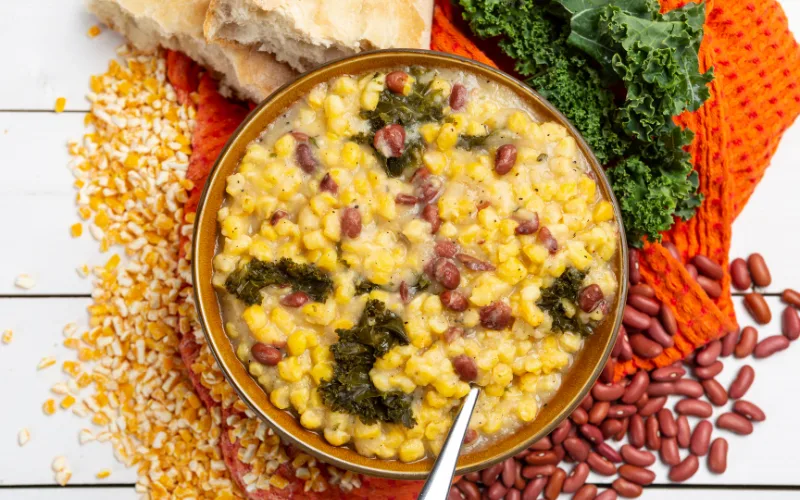
Cachupa, or katchupa in Creole, is the dish every Cape Verdean will recommend when you ask what to try: a corn and bean stew simmered for hours, with fish or meat depending on the household and the island. You will find it in several versions (rica, pobre, guisada), and no two recipes are quite alike.
In brief
- Cachupa is considered the national dish of Cape Verde: pounded corn and beans, cooked together for hours.
- The “rica” version is rich in meats (pork, sausages), while the “pobre” is simpler, often with fish; families do not all agree on where exactly the line between the two falls.
- The “guisada” (or “refogada”) is yesterday’s cachupa, reheated in a pan with onion and often an egg: the classic next-morning breakfast.
- Corn came from Brazil; the dish is a blend of Portuguese cooking (the cozido), American ingredients and African know-how.
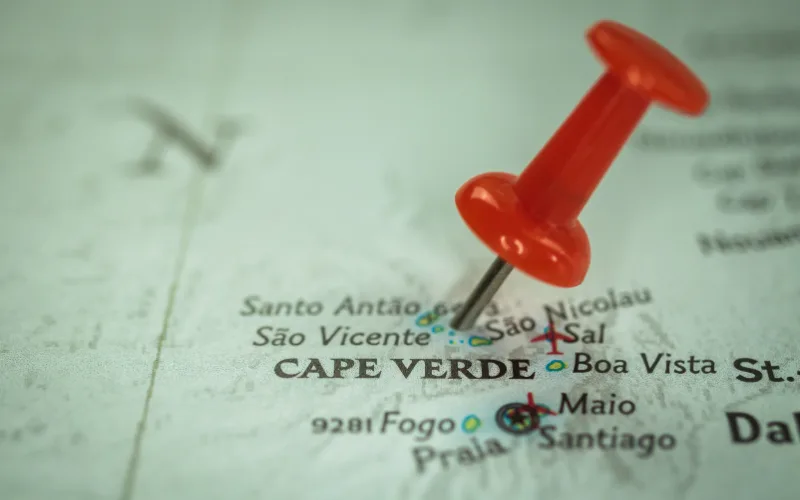
- To taste it, look for stalls and local-cuisine restaurants; on weekends in Praia, cooks sell it to take away from the street.
- Other dishes not to miss: caldo de peixe, sweet cuscuz, xerém, lagosta, and grogue to finish.
Planning a trip to Cape Verde?
Tell us about your plans: we will put you in touch with a local agency that knows every island and will prepare a proposal tailored to your interests and budget.
Where does cachupa come from?
It has no precise date of birth, but its ingredients tell its story. Corn came from Brazil, and beans and cassava followed the same route. The rest, pork, bacon and chorizo, comes from the Portuguese table, and one Cape Verdean author goes so far as to describe cachupa as a Portuguese cozido to which corn was added.
The dish was also born of necessity: communities without access to costly ingredients made corn the base and completed it with whatever they had, often fish. This double history, between celebration and frugality, explains why so many versions exist. To place the dish in the context of the archipelago’s settlement, our page on the history of Cape Verde and its people gives the useful landmarks.
Rica, pobre, guisada: the versions
The three names do not refer to three fixed recipes. They describe three ways of eating the same base, and sources differ on the details: some contrast meat (rica) with vegetables or fish (pobre), while others link the difference to the family’s budget. Remember the logic rather than a strict rule.
| Version | What’s in it | When it’s eaten |
|---|---|---|
| Cachupa rica | Corn, beans, several meats (pork, sausage, sometimes beef or chicken), vegetables | Festive meals or Sundays |
| Cachupa pobre | Corn, beans, few ingredients (onion, garlic, cabbage), tuna or nothing in place of meat | Everyday meals |
| Cachupa guisada or refogada | Leftovers from the day before, fried with onion, often with an egg | Next-morning breakfast |
Yesterday’s cachupa is no second-rate dish: many Cape Verdeans prefer the refogado, and some cooks deliberately make large quantities so they have it for several days.
Cachupa rica recipe for 6 people
Published recipes do not agree: one calls for 3 hours of cooking for 5 people with 1 litre of corn, another gives 1 h 30 with 1 kg of corn and much more generous amounts of meat. The version below follows the first for the corn and beans (it gives the clearest ratio) and the second for the list of meats and starches; adjust to taste, since every family has its own.
Ingredients
- 1 litre of pounded corn (hominy), about 800 g to 1 kg; allow 1 litre for 5 people, a little more for 6 (our adjustment).
- A third of a litre of mixed beans (red, lima or butter beans); one recipe uses 500 g of each per 1 kg of corn, which is much more.
- 2 litres of water.
- 150 g of bacon (smoked belly or toucinho), 1 kg of pork spare ribs, 1 medium chorizo and, if you like, 1 pig’s foot or 500 g of chicken.
- 2 large onions, 4 garlic cloves, 1 bay leaf, chilli to taste, salt.
- 400 g of sweet potato, 400 g of cassava or pumpkin (up to 500 g each, with yam and green banana in the fuller version).
- 6 leaves of kale or a quarter of a green cabbage.
Steps
- The day before, soak the corn and beans in cold water: at least one night, up to 24 hours.
- Bring the 2 litres of water to the boil, add the drained corn and beans, the bacon, the onions, the chopped garlic, the bay leaf and the chorizo.
- Simmer gently. Allow at least 1 h 30 and up to 3 hours depending on the corn: it should be nearly tender before you continue.
- Then add the pork spare ribs, the cabbage, the sweet potato and the cassava or pumpkin, making sure the stew does not dry out and stays thick and coating.
- Continue cooking gently, season with salt, add the chilli, then serve in deep bowls.
The next day, fry what is left in an oiled pan with onion and add a fried egg: this is the guisada, often served with sausage.
And the pobre? Remove all the meats and tubers and reduce the quantities: the pobre from a Portuguese recipe is made with only 0.5 litre of corn, a little under 0.5 litre of beans, about 1.5 kg of tuna and imperador in steaks, onions, garlic, bay leaf and cabbage. The fish is cooked in the water that is then used to moisten the corn and beans; the fat is lard, and cooking takes about 1 hour, soaking not included.
If you would like to taste the original before you leave, or find out where to get it on your island, ask the local agency to recommend good tables along your route.
Where to eat cachupa in Cape Verde
Cachupa is everywhere, but it is mostly eaten in home kitchens at midday, and bought in small restaurants rather than large hotels. In Praia, at weekends (especially Saturday morning), cooks set up their big pots on wood fires at the roadside: customers arrive from late morning, and portions are sold to take away in plastic containers. To pay in escudos, see our page on money and exchange in Cape Verde.
It varies by island: on São Vicente, cavala (mackerel) plays the role of everyday staple, whereas on Santiago, Fogo or Santo Antão, cachupa is more often at the centre of the table. To choose your island according to your tastes, our guide which island to choose in Cape Verde will help.
A record of 6,360 kg
In 2017, at the Badja ku Sol festival in Praia, the largest cachupa in the world was cooked: 6,360 kg, with more than 600 kg of corn, 300 kg of pork and 100 kg of chicken, plus beans and vegetables. The record, ratified by Guinness, was served to more than 30,000 people. The dish is not on the UNESCO lists: the only Cape Verdean element on them is morna, since 2019.
Other dishes to try
If you stay several days, the Cape Verdean table is not limited to cachupa. Here is what comes up most often.
| Dish | What it is | Good to know |
|---|---|---|
| Caldo de peixe | Fish soup (often mackerel) with potato, pumpkin and carrot | Served with rice |
| Xerém | Corn dish, served with a soup | A cousin of cachupa |
| Lagosta | Spiny lobster, steamed or in red sauce (suada) | A festive dish |
| Búzio | Large sea whelk | Coastal cuisine |
| Cuscuz | Steamed cake of sweetened cornmeal | At breakfast, with butter or coffee |
Before choosing where to dine, ask the local agency to suggest a food stop on the island where you are staying.
And the typical dessert?
There is no single dessert. You will mostly come across filhoses (sweet fritters, traditionally made with banana), cassava balls in honey and sweet cuscuz, often served with papaya jam. To finish, grogue, a sugarcane spirit distilled mainly on Santo Antão and Santiago, is drunk neat or as a punch, softened with condensed milk or molasses. It goes perfectly with a night of funaná, the traditional music and dance of the archipelago.
To include a meal with a local family or a tasting in your stay, tell the agency what you would like to try when planning your itinerary, or refer to our guide to organising your trip to Cape Verde.
Frequently asked questions
What is the typical dish of Cape Verde?
It is cachupa, a stew of corn, beans and meat or fish. It is considered the national dish and is mostly eaten at lunch.
What is the origin of cachupa?
Corn comes from Brazil, the stew logic from the Portuguese cozido, and the dish was built from modest ingredients. There is no precise date of origin.
What is the typical dessert of Cape Verde?
There is not just one: filhoses, cassava balls in honey and sweet cuscuz with papaya jam are the most common.
Can you eat vegetarian cachupa?
Yes, the base is corn and beans. Simply leave out the meat and fish and keep the vegetables; say so when you order, as many cooks add bacon.
Sources
- Cachupa (Wikipedia) (accessed 2026-11)
- Cachupa (Portuguese Wikipedia) (accessed 2026-11)
- Cape Verdean cuisine (Wikipedia) (accessed 2026-11)
- À descoberta da cachupa, Diário de Notícias, 26/08/2018 (accessed 2026-11)
- Cachupa à solta pelas ruas de Cabo Verde, RTP/Lusa (accessed 2026-11)
- World's largest cachupa stew made in Cape Verde, Guinness World Records, 17/10/2017 (accessed 2026-11)
- Cabo Verde, inscribed elements (UNESCO, intangible cultural heritage) (accessed 2026-11)
- Cachupa rica and cachupa pobre: receita, e-konomista (accessed 2026-11)
- Cachupa rica, recipe for 5 people, Maio Cape Verde (accessed 2026-11)
- Cachupa rica, seafood version, Kreol Magazine (accessed 2026-11)
- Cachupa: What is Cape Verde's National Dish?, Remitly (accessed 2026-11)
- Cachupa! Taste-Testing The National Dish Of Cape Verde, AFKTravel (accessed 2026-11)
Are you planning a trip to Cape Verde?
To organize your stay, we work with a local agency based in Cape Verde, which knows the archipelago island by island. Tailor-made tours, accommodation, inter-island flights, excursions: describe your project, we put you in touch and the agency prepares a proposal tailored to your wishes and budget.

Written by Adilson Gomes Garcia
Founder of Casa di CV and Gomia-Voyage, I was born in Santiago and I am committed to showcasing African territories, starting with Cape Verde. Through my platforms, I help travelers and curious minds better understand these destinations, their cultures and their realities, so they can plan authentic and respectful trips. My goal: to offer a clear, local and useful perspective for discovering Africa as it really is, with its riches and its identity.