
 Français
 Español
 Italiano
 Deutsch
 Português
 Русский
 Nederlands
 English
Contents
November is a very good time to visit Cape Verde: the summer rains are behind us, the trade winds return and the heat becomes comfortable, without the stifling humidity of September. The question is which island to pick, because November does not feel quite the same from one island to another. Here are the weather, the sea, the wind and the islands to favour.
In brief
- Air: 22 to 30 °C depending on the town, around 25 to 26 °C on average.
- Sea: about 26 °C, so pleasant for swimming without a wetsuit.
- Rain: 1 to 5 mm over the month at the reference stations; November is the first truly dry month after the rainy season.
- Sunshine: about 7 hours a day, slightly less on Sal than on São Vicente.
- Wind: the north-east trade winds return, steadier from November to May.
- For beach and kitesurfing: Sal or Boa Vista. For walking: Santo Antão or Fogo. For city life and music: São Vicente.
Planning a trip to Cape Verde?
Tell us about your project: we will put you in touch with a local agency that knows every island and will prepare a proposal tailored to your wishes and budget.

What is the weather like in Cape Verde in November?
In November the archipelago moves from the hot, humid season to the dry season. The storms of August to October, which can trigger landslides on the mountainous islands, are now a thing of the past, and residual rain is measured in millimetres. A few brief showers are still possible early in the month, especially on the southern islands and in the highlands, but they rarely spoil a day.
The figures below give an order of magnitude for three towns spread across the archipelago. They are multi-year averages, not a forecast for your travel week.
| Town (island) | Air in November | Sea and rain |
|---|---|---|
| Sal | 22.5 to 28 °C, average 25.2 °C | 25 °C, 1 mm |
| Mindelo (São Vicente) | 24 to 28 °C, average 25.6 °C | 26 °C, 5 mm |
| Praia (Santiago) | 23 to 30 °C, average 26.3 °C | 27 °C, 4 mm |
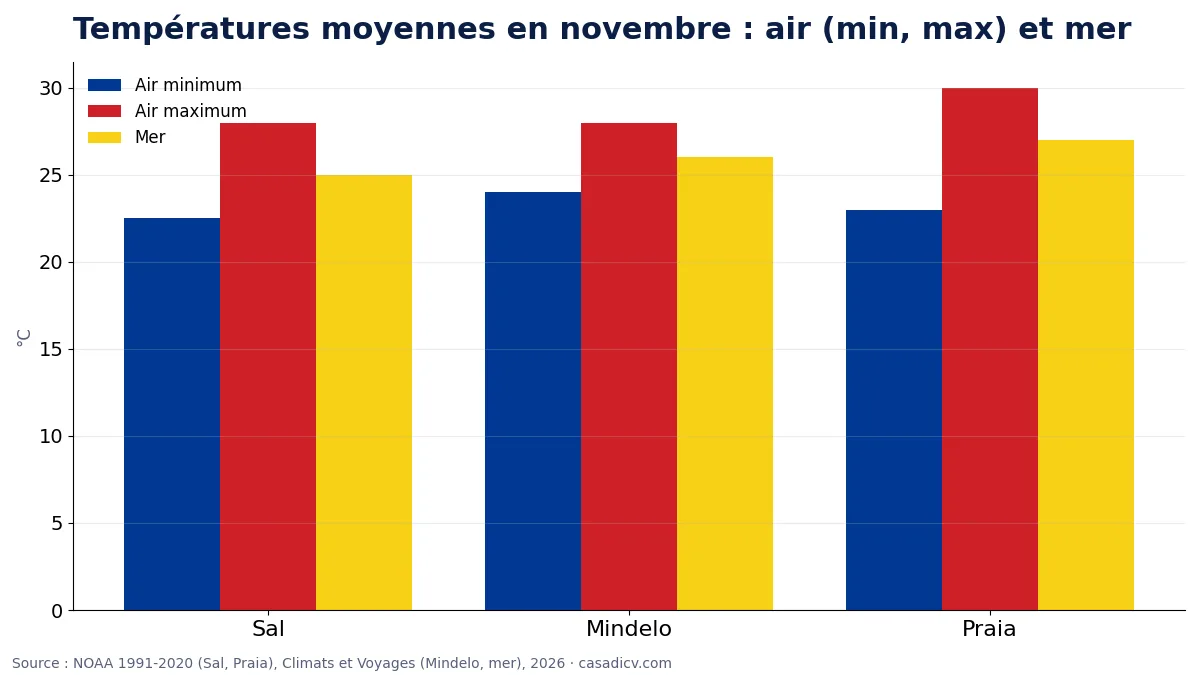
Praia is the warmest of the three, and its sea is also the mildest. Sal is the driest, but it is also the island that gets the least sunshine over the year, about 2,190 hours compared with 2,980 in Mindelo. A hazier sky will not stop you from enjoying the beach; just keep it in mind if you are counting on every ray.
Wind: the real factor in November
The trade winds blow almost constantly from November to May, around 12 to 27 km/h depending on the day. They cool the air pleasantly and attract windsurfers and kitesurfers to Sal and Boa Vista. If you want a windless beach for reading, choose a sheltered cove or rely on late morning, which is calmer.
The harmattan, the dry wind from the Sahara, can replace the trade winds on some days and load the air with dust, reducing visibility. It mainly affects winter, from December to March, and rarely November. As the sea can also be rougher on some days, have your boat trips confirmed the day before by your local agency.
Which island to choose in November?
November suits every type of traveller, but each island shines for a different reason.
Sal and Boa Vista: beach and wind
These two low, very dry islands offer almost guaranteed dry days and a sea at 25 or 26 °C. Santa Maria on Sal and Sal Rei on Boa Vista are ideal in November for swimming, boat trips and wind sports.


Santo Antão and Fogo: walking in the highlands
Once the rainy season is over, the trails become much more walkable, with no storms or waterlogged ground, both in the valleys of Santo Antão, dominated by Topo da Coroa (1,979 m), and on the slopes of Pico do Fogo (2,829 m). Even in the dry season, clouds still cling to the northern slopes, which remain greener: bring a light jacket for the altitude. You can have a custom hiking itinerary prepared by the local agency to fit ferry timetables and guides.


São Vicente: Mindelo and music
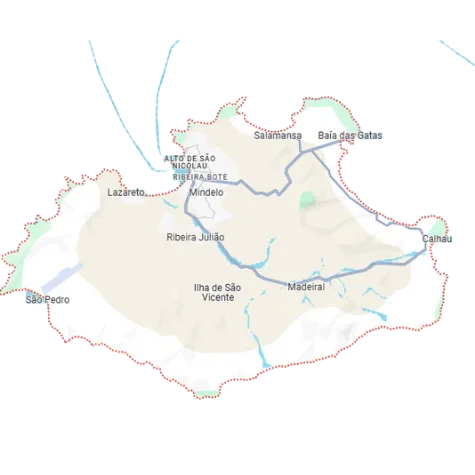
Sunnier than Sal, Mindelo is a great base for strolling, listening to live music in the evening and, if the urge strikes, taking a ferry to Santo Antão (CV Interilhas or Nôs Ferry). The Feira Internacional de Cabo Verde (FIC), a multi-sector trade fair, takes place on the island from 18 to 21 November 2026: book your accommodation early if you are passing through on those dates.
Santiago: history and culture
With the warmest sea of the three towns, Santiago is also good for swimming, but people come mainly for the history: in November you can visit Praia, the capital, Cidade Velha and the interior of the island without fear of heavy storms. For the other islands, our guide to choosing an island based on what you are looking for details the strengths of each.
Planning a trip to Cape Verde?
Tell us about your project: we will put you in touch with a local agency that knows every island and will prepare a proposal tailored to your wishes and budget.
November in practice
As far as weather safety goes, the Atlantic hurricane season officially ends on 30 November, and most of the risk falls earlier in the year: in November there is no particular cause for concern. For day-to-day safety, we cover it in detail in our page on dangers and tips for travelling with complete peace of mind.
For travel between islands, flights are operated by CVsky since 29 March 2026, and ferries by CV Interilhas, as well as Nôs Ferry between São Vicente and Santo Antão. International flights remain those of Cabo Verde Airlines and foreign carriers; our guide to airports and flights helps you choose your arrival. On arrival, the airport security tax (TSA) costs 3,400 CVE (about €31) online on ease.gov.cv, versus 6,800 CVE at the counter: pay it before you leave.
In your luggage, pack something to protect you from wind and sun: our Cape Verde packing checklist lists the essentials. And if you are unsure about the timing, our page on the best periods by climate compares November with other months, such as January or February.
For a trip combining beach and hiking, ask the local partner agency for a quote that splits your week between two islands.
Frequently asked questions
Is it safe to travel to Cape Verde in November?
Weather-wise, yes: the end-of-summer storms are over and the month is dry. For day-to-day life on the ground, our page on dangers and tips covers the useful precautions.
Can you swim in Cape Verde in November?
Yes, without a wetsuit. The wind can, however, make you feel chilly as you leave the water: bring a towel and a light windbreaker.
Sources
- Climats et Voyages: temperatures in Cape Verde in November (accessed 2026-11)
- Climats et Voyages: climate of Cape Verde, seasons and trade winds (accessed 2026-11)
- Partir.com: Cape Verde in November, weather (accessed 2026-11)
- Portugal Global: Feira Internacional de Cabo Verde 2026 (accessed 2026-11)
- NOAA: Atlantic hurricane season, 1 June to 30 November (accessed 2026-11)
- Sea temperature in Praia in November (accessed 2026-11)
- Sea temperature in Boa Vista in November (accessed 2026-11)
- Wikipedia: Sal, NOAA 1991–2020 climate table (Amílcar Cabral airport) (accessed 2026-11)
- Wikipedia: Praia, NOAA 1991–2020 climate table (accessed 2026-11)
- France Diplomatie: travel advice, Cape Verde (accessed 2026-11)
- EASE: entry procedure for Cape Verde (pre-registration) (accessed 2026-11)
- Wikipedia: Cape Verde, climate (rains from August to October, nine inhabited islands) (accessed 2026-11)
Are you planning a trip to Cape Verde?
To organize your stay, we work with a local agency based in Cape Verde, which knows the archipelago island by island. Tailor-made tours, accommodation, inter-island flights, excursions: describe your project, we put you in touch and the agency prepares a proposal tailored to your wishes and budget.

Written by Adilson Gomes Garcia
Founder of Casa di CV and Gomia-Voyage, I was born in Santiago and I am committed to showcasing African territories, starting with Cape Verde. Through my platforms, I help travelers and curious minds better understand these destinations, their cultures and their realities, so they can plan authentic and respectful trips. My goal: to offer a clear, local and useful perspective for discovering Africa as it really is, with its riches and its identity.