 Français
 Español
 Italiano
 Deutsch
 Português
 Русский
 Nederlands
 English
Contents
No government advises against travel to Cape Verde: the United Kingdom considers crime generally low, the United States ranks it at the lowest level of caution, and more than a million visitors come every year. France has raised its vigilance because of a rise in assaults, which calls for a few simple habits. Here is where the risks lie, island by island, from the sea to the trails.
In brief
- The sea demands the most respect: strong currents, beaches that are generally unsupervised and no sea rescue service, so swim where a lifeguard is present and follow the flags.
- France has raised its vigilance: assaults are on the rise, especially in Praia, and at night on foot you should take a taxi.
- Thefts mostly target pedestrians: jewellery and gold stay in the hotel, the phone goes deep in your bag, and you should not resist if someone tries to snatch it.
- Reported sexual assaults mostly affect women travelling alone: at night, take a taxi and stay in a well-located accommodation.
- Santiago and Fogo mountains, Boa Vista dunes: go with a guide, as there is no rescue helicopter; insurance covering evacuation is essential.
- Good news on health: malaria has been eliminated from the country since 2024.
Planning a trip to Cape Verde?
Tell us about your project: we will put you in touch with a local agency that knows every island and will prepare a proposal tailored to your wishes and budget.
What governments say
Advice ranges from “normal precautions” to “heightened caution”, with France and Canada placing greater emphasis on crime.
| Country | Position | Reason cited | Updated |
|---|---|---|---|
| France | Heightened vigilance across the whole territory (yellow zone) | Rise in armed assaults, beaches without sea rescue | 13 October 2026 |
| United Kingdom | No travel advisory | Generally low crime, dangerous sea | July 2026 |
| Canada | High caution | More frequent offences at night and in isolated areas, drowning | 26 May 2026 |
| United States | Level 1 out of 4 (normal precautions) | Crime | 18 December 2025 |
| Belgium | “Very limited” deterioration in security | Bag snatching, burglaries, beaches, storms | 20 August 2025 |
Assaults and theft: where, when, and what to do
What France reports: a rise in violent assaults, sometimes armed, by day and by night, in Praia and urban centres, on the medium-altitude trails of Santiago, and outside urban centres in Boa Vista and Fogo. Thefts, robberies and burglaries are also more frequent, people on foot are the most targeted, and attacks on visible gold (chains, wedding rings) are becoming regular.
| Location | Risk | Habit to adopt |
|---|---|---|
| Praia (Santiago) | Reported assaults by day and by night, mostly against pedestrians | Take a taxi rather than walk, stick to the busy centre only |
| Santiago mountains | Assaults on medium-altitude trails | Hike with a Cape Verdean guide |
| Mindelo (São Vicente) | Risk in town outside the busy areas of the centre | Do not walk alone outside the centre, take a taxi at night |
| Santa Maria (Sal) | Theft on the beach, strong currents | Leave nothing valuable on the towel, swim cautiously |
| Boa Vista | Assaults outside urban centres, dunes, unsupervised beaches | Dunes and tracks should be done accompanied, even during the day |
| Maio | Offences cited by Canada | Same precautions as elsewhere |
| Santo Antão | Risk mainly linked to trails and weather | Guide or marked itinerary |
| Fogo | Assaults outside urban centres, volcano, tremors, very long evacuation | Climb with a guide, allow margin in your schedule |
The risk is therefore concentrated on journeys on foot, at night and in isolated places, and it can be avoided. At night, take a taxi, either from a stand or called by your hotel, with a price agreed before getting in. In Santiago and São Vicente, if you are alone, stay in the busy areas of the city centre. Jewellery and gold stay at the hotel, as do your passport and large amounts of cash; keep your phone out of sight, and politely refuse unofficial porters at Praia airport. If someone snatches your bag, do not resist: a phone can be replaced. Having your itinerary checked by the local agency helps you choose a well-located accommodation and transfers that avoid night-time walking.
Planning a trip to Cape Verde?
Tell us about your project: we will put you in touch with a local agency that knows every island and will prepare a proposal tailored to your wishes and budget.
The sea: the risk we underestimate
A turquoise sea always tempts you to dive in, and that is the trap. Currents around the islands are very strong, several people drown every year, especially in Praia and on Sal, swimming is generally unsupervised, and there is no sea rescue service. Divers should also know that the archipelago has no recompression chamber.
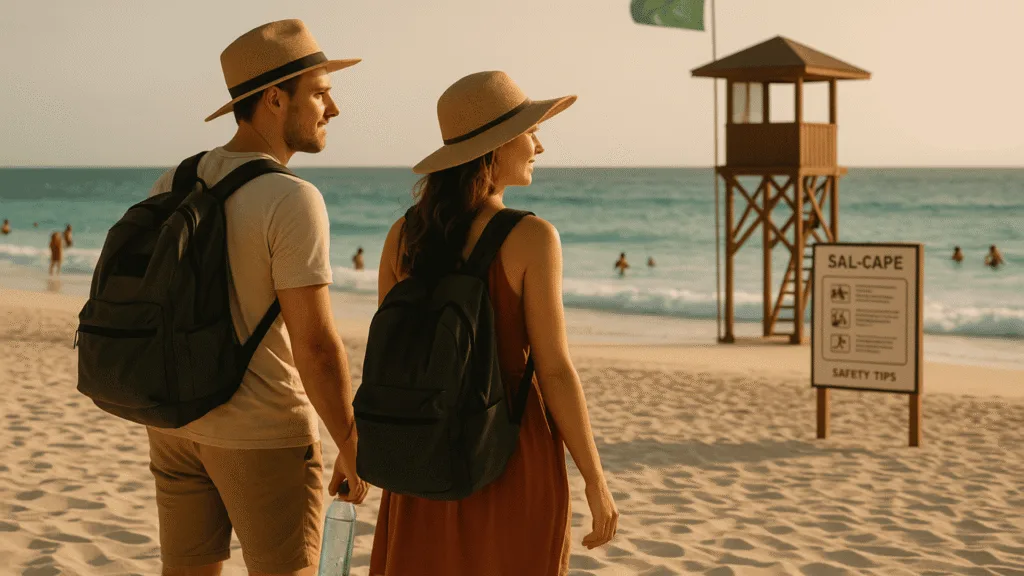
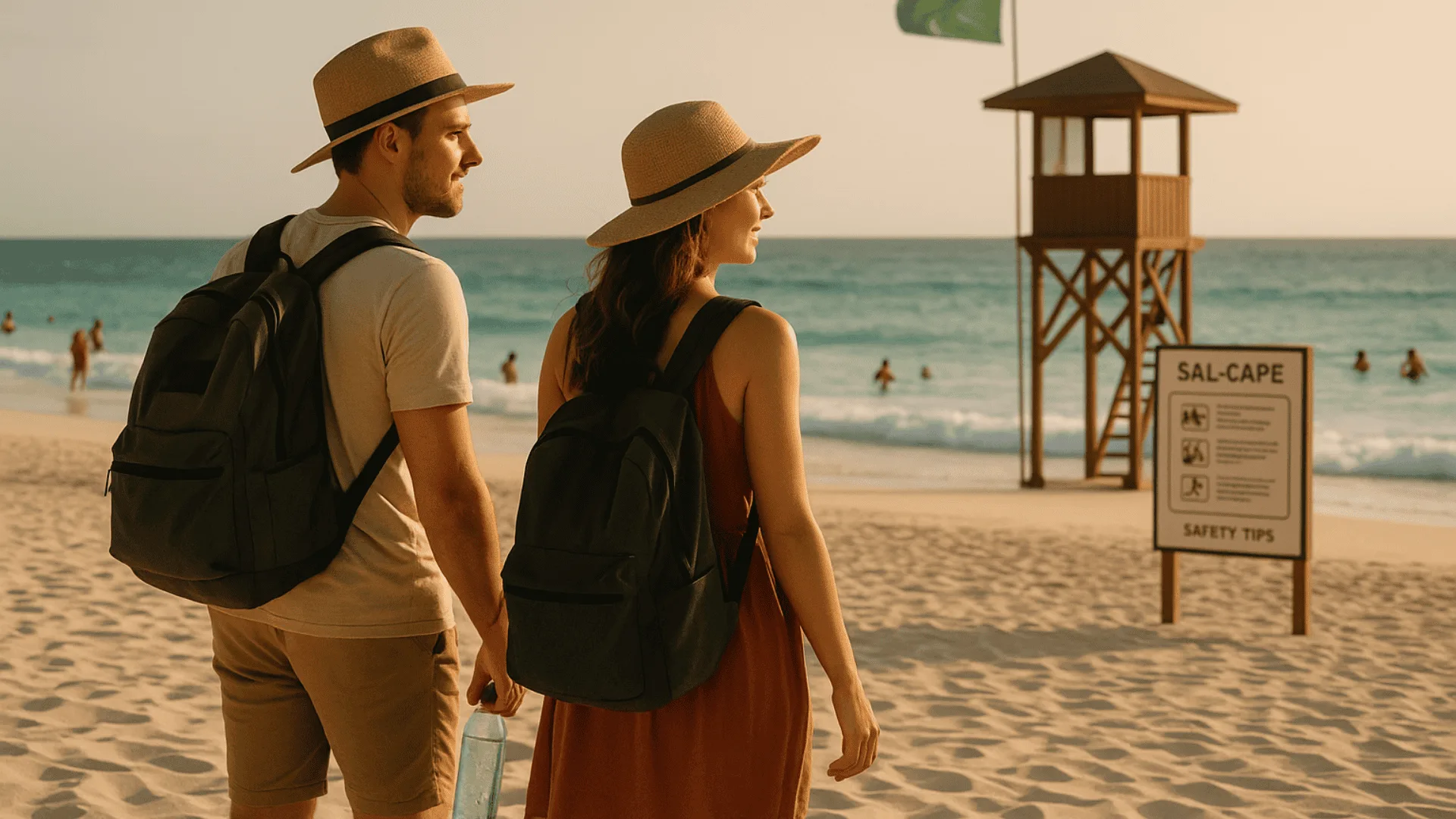
So swim cautiously, preferably where a lifeguard is present, and follow the flags: red, do not enter the water; yellow, you may wade but not swim; green, swimming is permitted. Never swim alone and wear sandals, as black sea urchins are found almost everywhere. Ask the local agency which beaches are the safest near your hotel so you do not have to find out on the spot.
Crossings between islands are often disrupted towards Brava and Fogo, so avoid booking a flight right after a boat trip. The options are detailed in our guide to getting around between the islands of Cape Verde.
Roads, buses and quads
Island roads are narrow, often paved, with animals roaming and crossing. Intercity buses can be dangerous because of the driving, and quad biking is considered an extreme sport: a helmet is mandatory on scooters and quads, and driving without a licence can lead to arrest.
Hiking and volcanoes
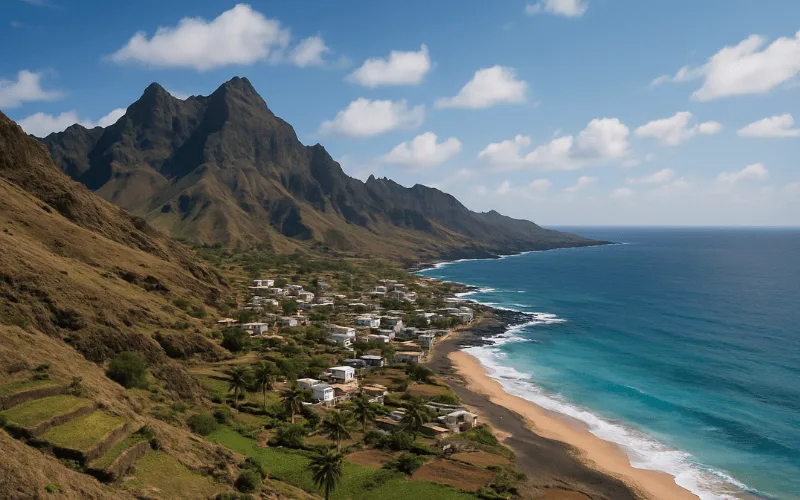
In Santiago, Fogo and Boa Vista, France recommends being accompanied in the mountains or dunes, even during the day, preferably by a Cape Verdean guide: the issue is as much safety against assaults as the terrain itself. There are no helicopters in Cape Verde, so after a fall on the Fogo volcano, evacuation can take a very long time. The climb requires very good fitness and is not suitable for children. Pico do Fogo and an undersea volcano near Brava are active; follow local information, and be aware that minor earthquakes affect the western islands.
Santo Antão adds fog, slippery trails and a patchy phone network in places. From August to October, heavy rain, landslides and flooding are possible. For routes, see whether hiking without a guide is possible in Cape Verde or what to do on Fogo, and booking a Cape Verdean guide through the local agency settles the question of accompaniment.
Health and animals
The former mention of sporadic malaria in Santiago is outdated: the WHO declared Cape Verde malaria-free on 12 January 2024, which means no preventive treatment is needed. Mosquitoes remain a concern: dengue is sporadic there, and other mosquito-borne diseases also exist, so insect repellent is still useful. Tap water should not be drunk, particularly on Sal and Boa Vista where it is desalinated and easily causes diarrhoea. A regional alert for measles has been issued since March 2026; our vaccination advice is in the guide to vaccines and health precautions.
As for animals, government advice does not mention snakes, spiders or sharks as a risk for travellers. The only dangers are black sea urchins, livestock on the road and, more rarely, rabies; any animal bite or scratch warrants prompt medical consultation.
Good facilities are found in the big cities, such as Praia and Mindelo; elsewhere, emergency services are slow and facilities very basic. As there is no helicopter, medical evacuation insurance is essential. The French embassy has limited capacity to help you: for a consular emergency, call +238 260 45 35, or +238 991 21 29 outside office hours. On site, the police can be reached on 132, medical assistance on 130, and the fire brigade on 131.
Describing your travel project to the local agency makes it possible to arrange suitable transfers and accommodation, including for families, with our advice on travelling to Cape Verde with children, or to choose between the islands with our guide to choosing your island.
Frequently asked questions
Is Cape Verde safe for a woman travelling alone?
France reports an increase in sexual assaults, of which women, particularly those travelling alone, are the main victims. A few habits reduce the risk: take a taxi back at night, avoid little-frequented neighbourhoods and isolated trails, be accompanied by a guide in the mountains, choose a well-located accommodation and arrange your transfers in advance.
Is Praia airport dangerous?
Not dangerous, but it is a place where you should be wary of unofficial porters who offer to carry your luggage. Keep your bags with you and use the official trolleys or taxis.
Is Cape Verde suitable for children?
Yes, provided you never leave them alone near the water, choose a sheltered beach and stay in the water with them. Sun and tap water are the other points to keep in mind, and the climb of the Fogo volcano is not suitable for children.
Sources
- France Diplomatie, Cape Verde: travel advice, security (13 October 2026) and measles alert of 13 March 2026 (accessed 2026-10)
- France Diplomatie, Cape Verde country sheet (beaches, vigilance, sea rescue) (accessed 2026-10)
- GOV.UK (FCDO), Cape Verde: safety and security (accessed 2026-10)
- Government of Canada, Cabo Verde travel advice (updated 26 May 2026) (accessed 2026-10)
- US Department of State, Cabo Verde (level 1, 18 December 2025) (accessed 2026-10)
- Belgian Diplomacy, General security in Cabo Verde (20 August 2025) (accessed 2026-10)
- NHS Fit for Travel, WHO certifies Cape Verde as malaria-free (accessed 2026-10)
- UN News, WHO declares Cabo Verde free of malaria (12 January 2024) (accessed 2026-10)
- Inforpress / INE, Cabo Verde received over 1.2 million guests in 2025 (accessed 2026-10)
- Forbes África Lusófona, guests in Cabo Verde in Q1 2026 (INE) (accessed 2026-10)
- Lonely Planet France, Safety and travel advice for Cape Verde (accessed 2026-10)
- Le Mag Voyage, Cape Verde: danger, safety and areas to avoid (30 April 2026) (accessed 2026-10)
Are you planning a trip to Cape Verde?
To organize your stay, we work with a local agency based in Cape Verde, which knows the archipelago island by island. Tailor-made tours, accommodation, inter-island flights, excursions: describe your project, we put you in touch and the agency prepares a proposal tailored to your wishes and budget.

Written by Adilson Gomes Garcia
Founder of Casa di CV and Gomia-Voyage, I was born in Santiago and I am committed to showcasing African territories, starting with Cape Verde. Through my platforms, I help travelers and curious minds better understand these destinations, their cultures and their realities, so they can plan authentic and respectful trips. My goal: to offer a clear, local and useful perspective for discovering Africa as it really is, with its riches and its identity.