
 Français
 Español
 Italiano
 Deutsch
 Português
 Русский
 Nederlands
 English
Contents
January is one of the most pleasant months to travel: the sky is clear, the heat is gentle and rain is almost absent. Just keep two things in mind before you book: the sea is pleasant without being warm, and the wind blows hard on the flat islands.
Here are the 1991-2020 averages from the archipelago’s weather stations, followed by the island that best fits your plans.
At a glance
- On the coast, expect 24 to 27 °C in the afternoon and 19 to 21 °C at night: you can live in T-shirts, with a light jacket for the evening.
- Rain is practically nonexistent on the coast (less than 3 mm for the month in Sal, 0.8 mm in Praia).
- The sea is around 23 °C in Sal: you can swim, but it is cooler than in autumn.
- The wind peaks from January to April, which makes Sal and Boa Vista great spots for kitesurfing and windsurfing.
- At altitude in Fogo or Santo Antão, it is around 15 °C in the afternoon, and at night it drops to 9 °C in Chã das Caldeiras.
- January is quiet for festivals (three public holidays, and Saint Amaro in Tarrafal on the 15th): you travel for the climate.
Planning a trip to Cape Verde?
Tell us about your project: we will connect you with a local agency that knows every island and will prepare a proposal tailored to your wishes and your budget.

The figures island by island
Cape Verde is a small archipelago, but the differences are real as soon as you climb in altitude. This table gives January averages for the stations with published measurements.
| Location | Max / min | Rain and sunshine |
|---|---|---|
| Sal (airport) | 25.0 / 19.2 °C | 2.8 mm, 5.9 h of sunshine per day |
| Praia (Santiago) | 26.7 / 19.8 °C | 0.8 mm, 7.2 h per day |
| Mindelo (São Vicente) | 24.4 / 20.5 °C | 4.8 mm, 7.4 h per day |
| Sal Rei (Boa Vista) | 25 / 19 °C | 2 mm |
| Porto Novo (Santo Antão, coast) | 24.0 / 20.1 °C | 7 mm |
| Espongeiro (Santo Antão, 1,371 m) | 15.5 / 10.9 °C | 24 mm |
| Chã das Caldeiras (Fogo, 1,764 m) | 14.8 / 8.7 °C | 11 mm |
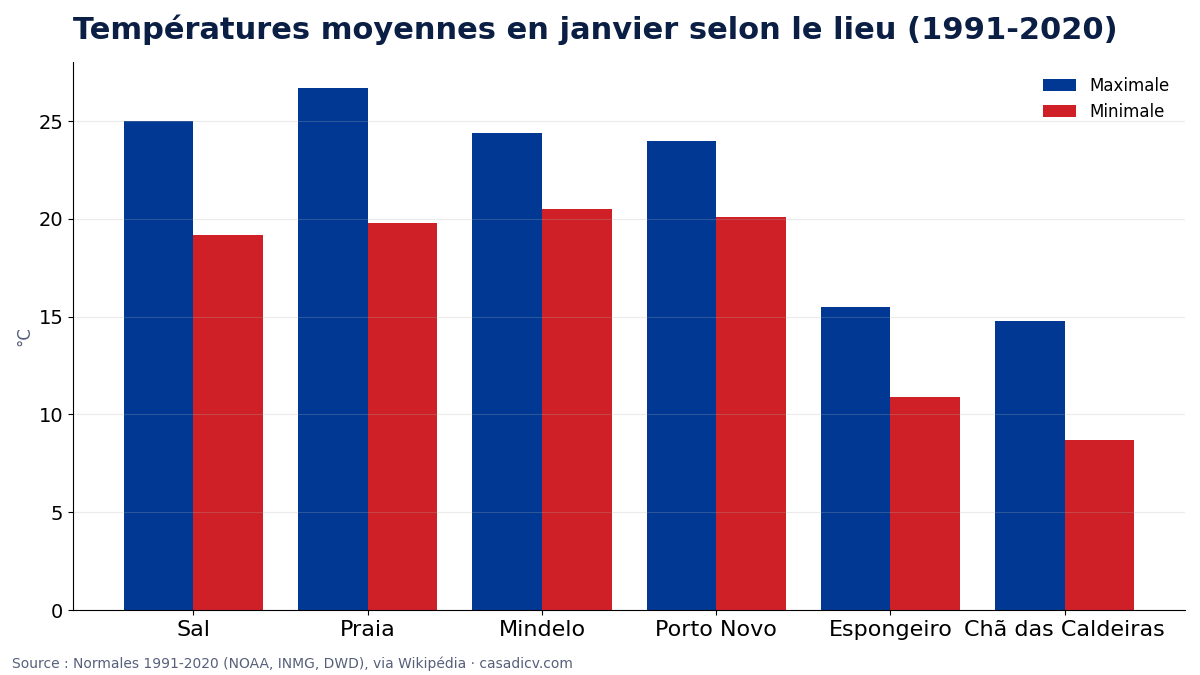
The takeaway is simple. At sea level the islands are alike: two to three degrees at most separate them. Mindelo has the mildest nights and Praia the hottest afternoons. As soon as you climb, everything changes: above 1,300 m you lose ten degrees, and rain, even if modest, is heavier there than on the coast.
To compare with other months and islands, our Cape Verde weather page covers the whole year, and when to visit Cape Verde compares the seasons.
Can you swim in January?
Yes. The sea is around 23 °C in Sal in January, which is pleasant for swimming. With 25 °C in the air and a breeze, you may feel chilly when you get out of the water: a thick towel and access to a hotel pool are a must.

Wind is the real issue in January on the flat islands. It blows hardest from January to April, which makes the beach less calm but makes watersports excellent in Sal and Boa Vista. If you mainly want to relax, choose a hotel or a stretch of beach sheltered from the wind. Ask the agency which accommodation is protected from the wind to avoid an unpleasant surprise.
Which island to choose in January
January suits almost every type of traveller, but in different ways. Here is how to decide based on what you are looking for:
- Beach and relaxation: Sal or Boa Vista. Both have 25 °C, very little rain and wide beaches. The wind is an asset if you enjoy kitesurfing, and a drawback if you want calm. The best hotels in Sal are a good starting point for comparing.
- Hiking: Santo Antão. In the middle of the dry season, the trails are passable and temperatures are comfortable for walking. Pack layers: you go from 24 °C on the coast to about 15 °C in the highlands.
- Volcano and cool nights: Fogo. The ascent of Pico do Fogo is made with a local guide. In Chã das Caldeiras, the average January night temperature is 8.7 °C: a warm sweater and a windbreaker are essential.
- Music, city and bright sun: São Vicente or Santiago. Mindelo and Praia are the sunniest of our readings, with more than 7 hours of sunshine per day compared with 5.9 hours in Sal.

If you are still torn between these options, our guide to choosing your island covers each island in detail.

A trip combining two islands is easier to plan with someone who knows the flight and ferry schedules: have a January itinerary built by the local agency so you don’t waste time on site.
Planning a trip to Cape Verde?
Tell us about your project: we will connect you with a local agency that knows every island and will prepare a proposal tailored to your wishes and your budget.
What happens in January?
January is a quiet month for festivals, which is no drawback if you come for the climate. Three public holidays punctuate the month: 1 January, 13 January (Dia da Democracia, commemorating the first free elections in 1991) and 20 January (Dia dos Heróis Nacionais, in memory of Amílcar Cabral). Government offices and banks are closed on those days, so exchange your euros the day before.
In Tarrafal, on Santiago, the town celebrates Saint Amaro every year on 15 January: if you are staying on that coast, the date is worth a detour. The 2027 programme has not yet been published, so check locally.

What January can complicate
January falls within the harmattan season, a dry wind from the Sahara that can veil the sky with dust, from November to March. A denser sandstorm, the bruma seca, can also occur from December to February. Most often, it simply means a milky horizon. On 23 January 2018, a dust storm in Praia reduced visibility enough to ground flights across the archipelago for two days. It was an isolated case, not a rule, but it is a good reason not to schedule a tight inter-island flight on the day before your return flight.
As for packing, keep it light but not summer-only: our packing checklist tells you what to bring, and if you are weighing another sunny winter destination, the Cape Verde or Canary Islands comparison may help you decide.
January prices depend heavily on the island and your dates: for a precise budget, the most reliable option is to receive a firm quote for your dates from our partner local agency.
Frequently asked questions
What is the temperature in Cape Verde in January?
On the coast, the average daily high is 24 to 27 °C and the average low is 19 to 21 °C. At altitude, in Fogo or Santo Antão, it is around 15 °C in the afternoon, and at night it drops to 9-11 °C.
Does it rain in Cape Verde in January?
Very little: less than 3 mm for the month in Sal, 0.8 mm in Praia. At altitude, in Santo Antão and Fogo, 11 to 24 mm are recorded, which remains low.
Is there Saharan dust in January?
It is harmattan season, from November to March. A hazy sky is common, and rare denser episodes can disrupt flights. Keep a margin before a return flight.
Sources
- Sal, Cape Verde (climate data, 1991-2020 normals), Wikipedia (accessed 2026-11)
- Praia (climate data, 1991-2020 normals), Wikipedia (accessed 2026-11)
- Mindelo (climate data), Wikipedia (accessed 2026-11)
- Sal Rei (climate data), Wikipedia (accessed 2026-11)
- Fogo, Cape Verde (climate data for Chã das Caldeiras), Wikipedia (accessed 2026-11)
- Santo Antão, Cape Verde (climate), Wikipedia (accessed 2026-11)
- Weather and climate in Cape Verde in January, ilesducapvert.fr (accessed 2026-11)
- Cape Verde Under Dust, NASA Terra (accessed 2026-11)
- Dry fog in Praia, Cape Verde (23 January 2018), UC Santa Barbara (accessed 2026-11)
- Climate and disasters in Cabo Verde, Belgian Federal Public Service Foreign Affairs (accessed 2026-11)
- Public holidays in Cape Verde, Wikipedia (accessed 2026-11)
- Cape Verde Under Dust, NASA Earth Observatory (accessed 2026-11)
- Tarrafal, Barceló travel guide (15 January festival) (accessed 2026-11)
Are you planning a trip to Cape Verde?
To organize your stay, we work with a local agency based in Cape Verde, which knows the archipelago island by island. Tailor-made tours, accommodation, inter-island flights, excursions: describe your project, we put you in touch and the agency prepares a proposal tailored to your wishes and budget.

Written by Adilson Gomes Garcia
Founder of Casa di CV and Gomia-Voyage, I was born in Santiago and I am committed to showcasing African territories, starting with Cape Verde. Through my platforms, I help travelers and curious minds better understand these destinations, their cultures and their realities, so they can plan authentic and respectful trips. My goal: to offer a clear, local and useful perspective for discovering Africa as it really is, with its riches and its identity.