
 Français
 Español
 Italiano
 Deutsch
 Português
 Русский
 Nederlands
 English

Contents
In Cape Verde, the weather is mild all year round: on the coast, it almost never drops below 18 °C at night or rises above 30 °C during the day. What really sets one period apart from another is the wind, the humid heat of late summer and the rain on the mountainous islands, and these vary depending on the island where you choose to stay.
In brief
- The dry season runs from November to June; the rains, short and irregular, fall mainly in September and October.
- At sea level, the temperature difference between the islands does not exceed two degrees: you choose your island for the wind, the terrain and the rain, not for the heat.
- The wind is strongest from December to May, peaking in February; it drops noticeably from July to September.
- The flat islands (Sal, Boa Vista, Maio) stay dry almost all year; the mountainous islands (Santo Antão, São Nicolau, Santiago, Fogo, Brava) are cooler at altitude and wetter on their heights.
- November and June are the most agreeable months, December to May suit windsurfing and kitesurfing, and January to March suit hiking.
Planning a trip to Cape Verde?
Tell us about your project: we will connect you with a local agency that knows every island and will prepare a proposal tailored to your wishes and budget.
Two seasons, and a trade wind that makes the difference
The calendar reads in two parts. From November to June, the sky is clear and it hardly rains at all; from July to October, the air becomes more humid, the sea reaches its peak warmth and showers arrive. In Sal, about 165 mm of rain falls over the year, more than half of it in September and October, and these showers turn the mountains of the mountainous islands green within a few weeks.
In the dry season, the northeast trade wind itself has two moods: a steady wind that cools the air from December to May, then calmer heat from June onwards. Our guide when to visit Cape Verde matches these seasons with your wishes.
The weather month by month
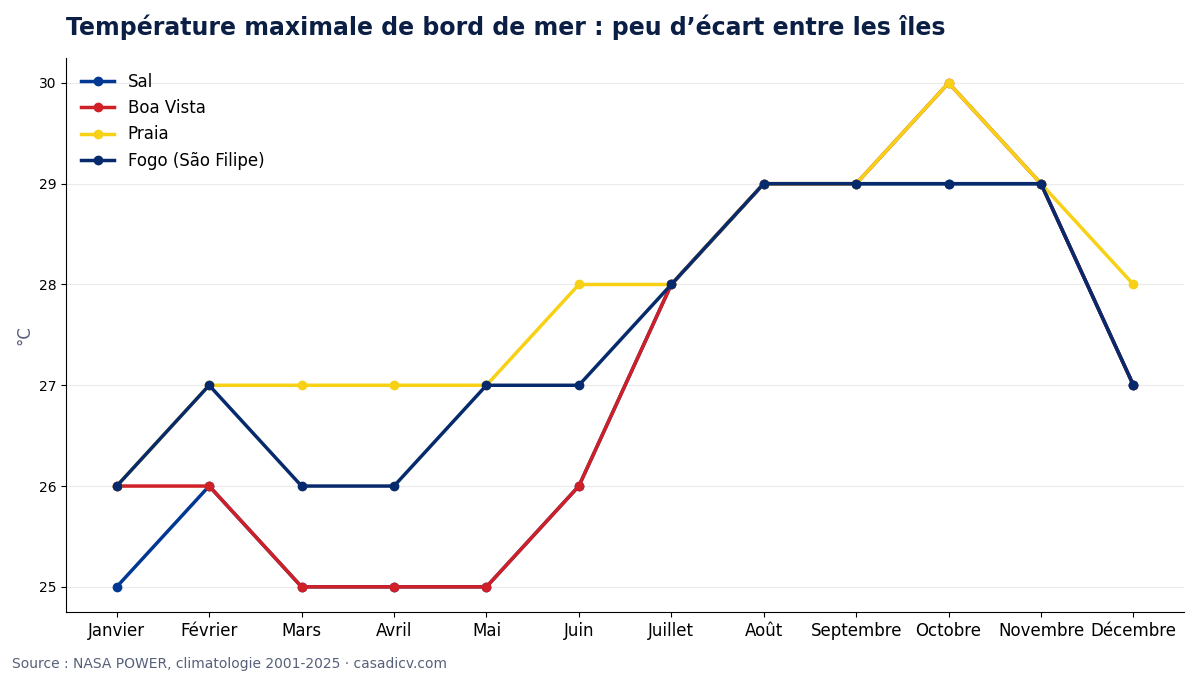
The table compares four coastal reference points, which shows at a glance how similar the islands are. Temperatures are the 2001-2025 averages from NASA; sea and rain data come from published records for Sal and Praia, and they vary from one record to another, hence the ranges.
| Month | Sal (max / min °C) | Boa Vista | Praia | Fogo | Sea: Sal / Praia (°C) | Rain: Sal / Praia (mm) | In a word |
|---|---|---|---|---|---|---|---|
| January | 25 / 19 | 26 / 19 | 26 / 19 | 26 / 20 | 22 / 24 | 13 / 0 | Dry, cool, windy |
| February | 26 / 19 | 26 / 19 | 27 / 19 | 27 / 19 | 22 / 23 | 11 / 0-6 | The windiest month: kitesurfing |
| March | 25 / 18 | 25 / 19 | 27 / 19 | 26 / 19 | 22 / 23 | 4 / 0 | Dry, sunny, strong breeze |
| April | 25 / 19 | 25 / 20 | 27 / 20 | 26 / 20 | 22 / 22-23 | 1 / 0 | Dry, steady breeze |
| May | 25 / 20 | 25 / 20 | 27 / 20 | 27 / 20 | 22 / 23-24 | 6 / 0 | Dry, sea still cool |
| June | 26 / 20 | 26 / 20 | 28 / 21 | 27 / 21 | 23 / 23-24 | 1 / 0 | Heat rising, wind easing |
| July | 28 / 21 | 28 / 21 | 28 / 22 | 28 / 22 | 24 / 24-26 | 8 / 3-5 | More humid, light wind |
| August | 29 / 23 | 29 / 23 | 29 / 24 | 29 / 24 | 26 / 26-27 | 15 / 9-55 | Hot, sea at 26 °C, first rains |
| September | 29 / 25 | 29 / 25 | 29 / 24 | 29 / 24 | 26 / 26-28 | 52 / 21-75 | Among the hottest, and the wettest |
| October | 29 / 24 | 30 / 24 | 30 / 24 | 29 / 24 | 26 / 27-28 | 36 / 25-33 | Warmest sea, rain receding |
| November | 29 / 22 | 29 / 22 | 29 / 23 | 29 / 23 | 26 / 26-27 | 7 / 0-5 | Dry season returns: a very good month |
| December | 27 / 21 | 27 / 21 | 28 / 21 | 27 / 21 | 24 / 24-25 | 10 / 0-10 | Mild, dry, wind established |
In practice, expect a cool sea (22 °C) from January to May, warming to 26 or 27 °C in autumn. If you are travelling with young children or feel the cold easily, November and June are the months when the water and the air agree best. With these figures, the first chart shows how closely the curves overlap from one island to another.
Two occasional phenomena are worth knowing about. Between November and March, the Saharan wind can bring fine dust that yellows the sky and reduces visibility; it covered the archipelago in February 2014 according to satellite images, and people with asthma are advised to bring their medication. In addition, the Atlantic hurricane season runs from 1 June to 30 November, peaking around 10 September, which overlaps with the rainy period: in September or October, a flexible fare and cancellation insurance are a sensible precaution. To pin your stay to a specific date, ask the local agency which weeks suit your island best.
The wind, island by island
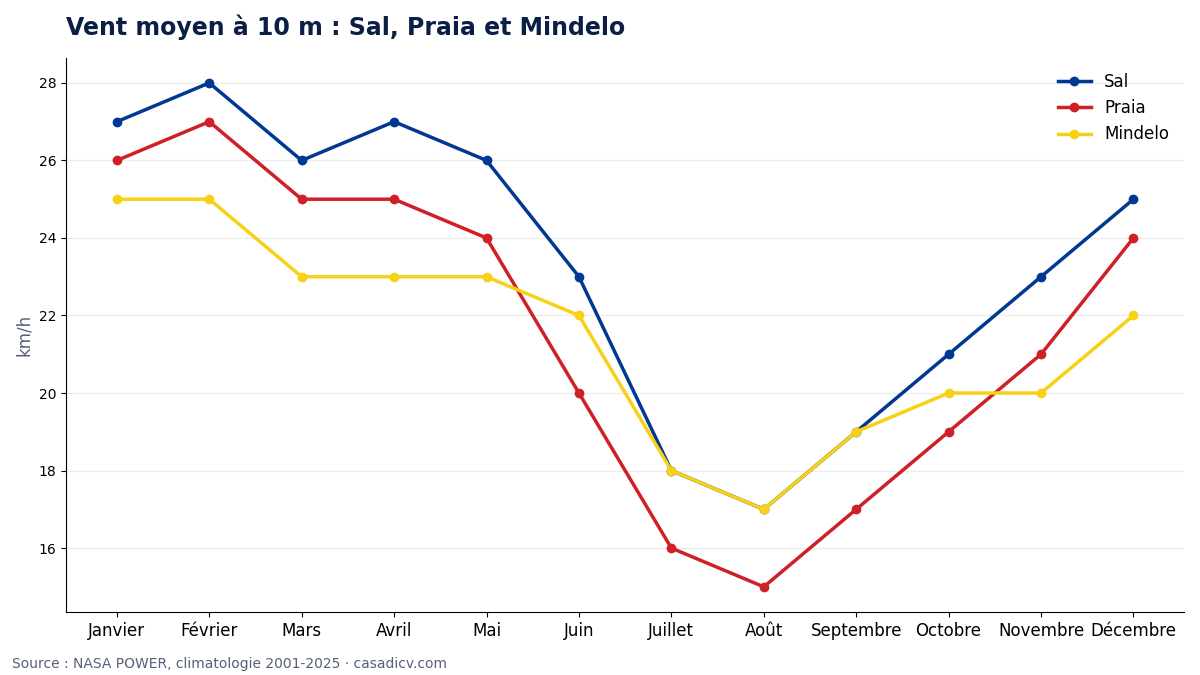
Wind is the factor that varies most from one island to another: Sal gets the strongest, Praia a little less, and Mindelo stays more consistent from one month to the next.
| Month | Sal (km/h) | Praia (km/h) | Mindelo (km/h) |
|---|---|---|---|
| January | 27 | 26 | 25 |
| February | 28 | 27 | 25 |
| March | 26 | 25 | 23 |
| April | 27 | 25 | 23 |
| May | 26 | 24 | 23 |
| June | 23 | 20 | 22 |
| July | 18 | 16 | 18 |
| August | 17 | 15 | 17 |
| September | 19 | 17 | 19 |
| October | 21 | 19 | 20 |
| November | 23 | 21 | 20 |
| December | 25 | 24 | 22 |
What changes depending on the island
Sal and Boa Vista
These two flat, desert islands offer no relief to hold back clouds: the sun is generous, rain is rare outside September and October, and the wind sweeps across them unobstructed. This is what makes them a playground for kitesurfers from December to May, but it is also what can turn a beach lounger without a windbreak into a challenge in February. If you are aiming for the beach, choose November or June, or a well-sheltered hotel. For Boa Vista, our Boa Vista page details what to do there depending on the season.

Santiago and Maio
Praia, on the south coast of Santiago, is the hottest city in the table, with nights that stay mild and wind slightly weaker than in Sal. Rain is concentrated there from August to October. As soon as you head inland on Santiago, the air cools and the vegetation is greener after the rains. Maio, very close by, is flat and dry like Sal: an island of quiet beaches best enjoyed from November to June.
Fogo and Brava
At the foot of the volcano, in São Filipe, the thermometer reads almost the same as in Praia. But Fogo is a cone that rises very high, and the temperature drops noticeably with altitude: bring a fleece for the climb to the crater, even in the middle of the dry season. Ascents are most pleasant from November to May, when the air is dry; the sticky heat of August and September is best avoided. Brava, its neighbour, shares this terrain. Our ideas for things to do in Fogo take these seasons into account.

São Vicente and Santo Antão
Mindelo is a very dry town where rain stays rare all year and the wind blows regularly; a light jacket for evenings by the waterfront is useful. Santo Antão, just across the channel, is a mountain island: the trails are greener and wetter at altitude, and hiking days are most comfortable from October to June, after the rains and before the sticky heat of summer. Our best hikes on Santo Antão will help you choose a route, and the local agency can fit the programme to your dates.

São Nicolau
Mountainous like Santo Antão, but far less visited, São Nicolau is best discovered between November and May for hiking, with a light jacket for the ridges. Readers torn between all these atmospheres will find some pointers in which island to choose based on what you’re looking for.
Planning a trip to Cape Verde?
Tell us about your project: we will connect you with a local agency that knows every island and will prepare a proposal tailored to your wishes and budget.
Finally, a simple tip: if you are torn between two periods, request a costed proposal for each and compare the price, the sea and the wind.
Frequently asked questions
What is the weather like in Cape Verde in November?
The dry weather is back: in Sal, it is around 29 °C during the day and 22 °C at night, with a sea at 26 °C and very little rain. It is one of the best months for the beach as well as for hiking.
Which month is the rainiest?
September, with 52 mm in Sal, followed by October (36 mm). The rest of the year, Sal gets 15 mm or less per month.
Can you swim all year round?
Yes: the sea stays between 22 and 28 °C depending on the island and the month. It is coolest from January to May and warmest from August to November.
Sources
- NOAA National Hurricane Center: climatology of the Atlantic hurricane season (accessed 2026-10)
- NASA Earth Observatory: Cape Verde Under Dust (Harmattan, 2014) (accessed 2026-10)
- NASA POWER: 2001-2025 climatology of maximum and minimum temperatures in Sal (accessed 2026-10)
- NASA POWER: 2001-2025 climatology of maximum and minimum temperatures in Boa Vista (accessed 2026-10)
- NASA POWER: 2001-2025 climatology of maximum and minimum temperatures in Praia (accessed 2026-10)
- NASA POWER: 2001-2025 climatology of maximum and minimum temperatures in Fogo (accessed 2026-10)
- NASA POWER: 2001-2025 climatology of wind in Sal (accessed 2026-10)
- NASA POWER: 2001-2025 climatology of wind in Praia (accessed 2026-10)
- NASA POWER: 2001-2025 climatology of wind in Mindelo (accessed 2026-10)
- Climate-Zone: Espargos (Sal), 1991-2020 normals (NOAA station), rainfall (accessed 2026-10)
- Weather2Travel: sea temperature in Sal (accessed 2026-10)
- Partir.com: sea and rain in Praia (accessed 2026-10)
- Climats et Voyages: sea and rain in Sal and Praia (accessed 2026-10)
Are you planning a trip to Cape Verde?
To organize your stay, we work with a local agency based in Cape Verde, which knows the archipelago island by island. Tailor-made tours, accommodation, inter-island flights, excursions: describe your project, we put you in touch and the agency prepares a proposal tailored to your wishes and budget.

Written by Adilson Gomes Garcia
Founder of Casa di CV and Gomia-Voyage, I was born in Santiago and I am committed to showcasing African territories, starting with Cape Verde. Through my platforms, I help travelers and curious minds better understand these destinations, their cultures and their realities, so they can plan authentic and respectful trips. My goal: to offer a clear, local and useful perspective for discovering Africa as it really is, with its riches and its identity.