 Français
 Español
 Italiano
 Deutsch
 Português
 Русский
 Nederlands
 English
Contents
- At a glance
- One beach per island: which one for which trip
- Sal: Santa Maria, the most convenient beach
- Boa Vista: the great beaches and dunes
- São Vicente: Mindelo’s beaches and wind
- Maio, Santiago and Santo Antão: the other faces of the coast
- Swimming in Cape Verde without bad surprises
- Turtle beaches, from July to September
- Frequently asked questions
- Sources
If you are looking for the postcard beach, head for Boa Vista and Sal: this is where the great stretches of pale sand are. If you prefer fishing coves, wind for kitesurfing or near-total calm, Maio, São Vicente and Santiago each have something to offer. Swimming goes very well here, as long as you know a couple of basic habits.
At a glance
- Boa Vista has 55 km of beaches in total, with seven major stretches of sand (Atalanta, Cabral, Chaves, Ervatão, Gatas, Santa Mónica, Varandinha) and dunes behind them.
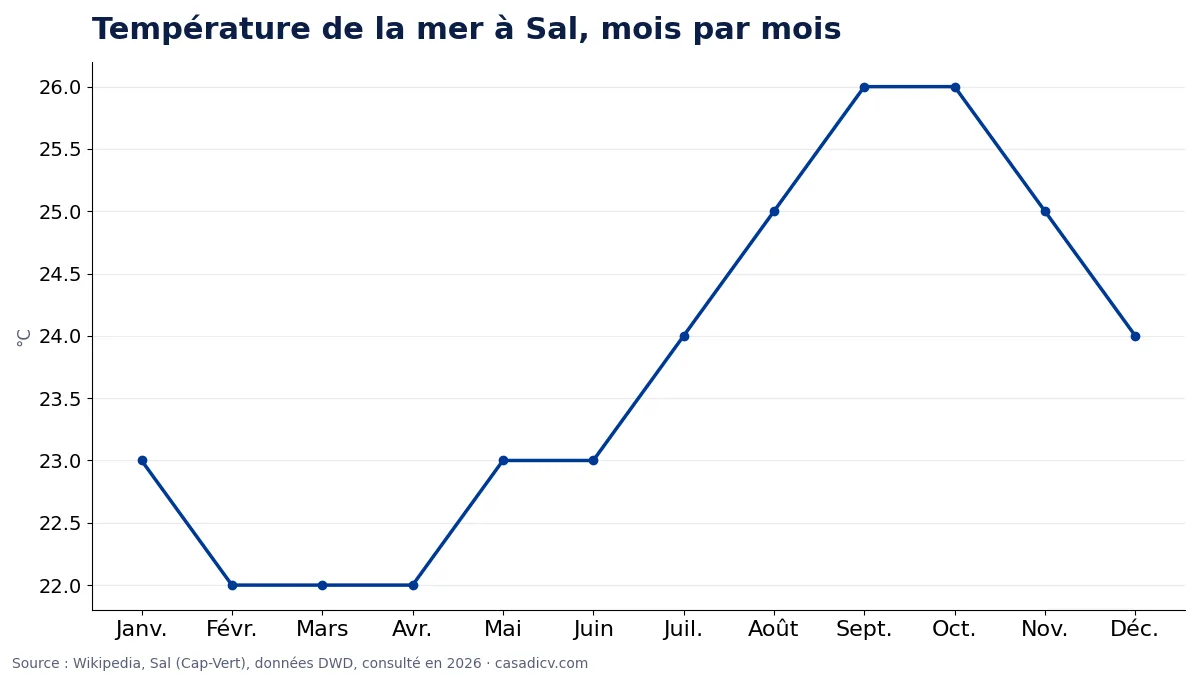
- Sal offers the most comfort: Santa Maria, a white-sand beach, has most of the island’s hotels and watersports schools; the water is 23 °C in January.
- São Vicente has Baía das Gatas, Calhau and São Pedro, a few kilometres from Mindelo; São Pedro is a national reference for windsurfing.
- Maio is the island of almost deserted beaches; Santiago has Tarrafal Bay; Santo Antão has only a few black volcanic sand beaches.
- Currents and waves are strong on many beaches: enter the water gradually and do not swim far from the shore.
- From June to October, sea turtles nest on the beaches of Sal and Boa Vista; night-time viewing is only allowed with a licensed guide.
Planning a trip to Cape Verde?
Tell us about your project: we will put you in touch with a local agency that knows every island and will prepare a proposal tailored to your wishes and budget.

One beach per island: which one for which trip
The archipelago does not feel like a single beach destination. The eastern islands, flat and sandy, have the longest beaches; the western ones, volcanic and steep, mostly have rocky coastlines where swimming comes after hiking. So choose a beach the way you choose an island, based on what you want to do for the rest of the day. The table below helps you see things clearly before the details.
| Island | Beaches to know | Best for |
|---|---|---|
| Sal | Santa Maria, Ponta Preta, Kite Beach | First-timers, wind sports, comfort |
| Boa Vista | Santa Mónica, Chaves, Varandinha | Wide open spaces, dunes, turtles |
| São Vicente | Baía das Gatas, Calhau, São Pedro, Laginha | Windsurfing, music, city stays |
| Maio | Coastal beaches, often deserted | Calm, nature, off the beaten track |
| Santiago | Tarrafal Bay | Culture, fishermen, a swimming break |
| Santo Antão | A few black sand beaches | Hikers, not swimmers |
Torn between two islands? Describe your trip to the local agency and they will tell you where the sea will be most pleasant on your dates.
Sal: Santa Maria, the most convenient beach
Sal is flat, dry and very oriented toward the sea. Santa Maria, in the south, is where most visitors end up: the white-sand beach borders a former fishing village turned resort, about fifteen kilometres from the airport. Tourist development began after 1986, and in 2017 the island held nearly half of the country’s accommodation beds (48.2%). What matters for you is that everything is within walking distance: restaurants, equipment rental, kitesurfing, windsurfing and surfing lessons.

Sports enthusiasts can go a bit further. Ponta Preta, a few kilometres to the northwest, is known for its right-hand wave and offshore winds, while Kite Beach, north of Santa Maria on the east coast, mostly gets crosswinds. Under the water, Sal has plenty to offer too: our guide to diving in Cape Verde covers the spots and marine life. For the rest of the island (the Pedra de Lume salt pans, villages, walks), see our page on Sal.
Boa Vista: the great beaches and dunes
Boa Vista is the island of sand as far as the eye can see. Its coastline stretches for 55 km of beaches, and more than a third of its territory (37%) is protected, the highest proportion among the inhabited islands. Santa Mónica, in the southwest, is the beach most often cited for its length and white sand; Chaves, further west, is lined with dunes and is barely developed. Inland, the Viana desert reminds you that the island is a vast field of dunes.

The downside of such vastness is distance: the most beautiful beaches are far from Sal Rei, the capital, so plan for a hotel close to the sea or a vehicle. The calm is very real, but the sea can be rough. Our page on Boa Vista lists what to do beyond the beach, and the local agency can arrange your transfers to the remote beaches.
São Vicente: Mindelo’s beaches and wind
On São Vicente, people swim around Mindelo, the cultural capital of the archipelago. Baía das Gatas, Calhau and São Pedro are three very popular beaches; Laginha, right at the edge of the city, is described as a powdery white-sand beach. Watersport lovers head to São Pedro, one of the best places in the country for windsurfing. Baía das Gatas hosts, every year on the first full-moon weekend of August, one of the best-known music festivals on the island.
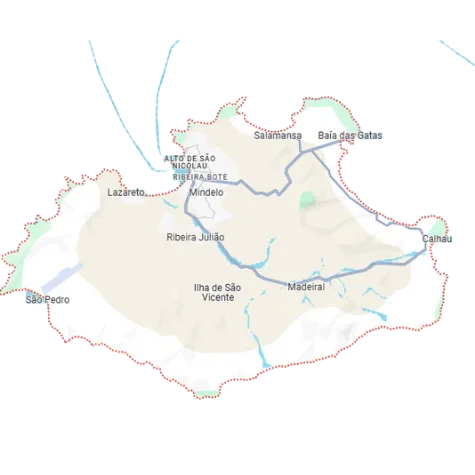
Here, the beach complements an urban stay rather than dictating it. For the rest, our page on São Vicente will give you plenty to fill your days.
Maio, Santiago and Santo Antão: the other faces of the coast
Maio is the most discreet of the beach islands: 269 km², fewer than 7,000 inhabitants, dunes to the north and beaches described as almost deserted. It has also been a biosphere reserve since 2020. If you want to get away from the crowds, discover Maio, its immense beaches and its marine life.
On Santiago, Tarrafal Bay nestles at the foot of Monte Graciosa (643 m) around a fishing port. It is the island’s best-known beach and one of the two most visited in the country, along with Santa Maria. For the rest of the island, see our guide to Santiago.
Santo Antão, finally, is mostly made of cliffs dropping sharply into the sea. A few black volcanic sand beaches, such as the one at Tarrafal de Monte Trigo, do exist, but the island is best approached with hiking boots rather than a swimsuit.
Swimming in Cape Verde without bad surprises
The sea is pleasant at almost any time of year: on Sal, it ranges from 22 °C from February to April to 26 °C in September and October. Air temperatures are just as mild in midwinter: in January, average daily highs reach 25.0 °C on Sal (lows of 19.2 °C) and 26.7 °C in Praia (lows of 19.8 °C).
Then there are the currents: swimming can be dangerous because of strong currents and powerful waves, and this applies to many beaches. In practice, enter the water gradually, stay within your depth, do not swim out alone, and preferably choose a busy beach where other swimmers are present, such as Santa Maria. You will also find black sea urchins almost everywhere: beach sandals are enough to cross the rocky areas.
One last, more mundane habit: on the busiest beaches, those of Santa Maria and Tarrafal, keep an eye on your belongings, or leave them at the hotel.
Turtle beaches, from July to September
All the beaches of Sal are nesting beaches, and Boa Vista alone hosts 60 to 70% of the country’s nesting population. Nesting spreads from June to October: during these months, going to the beach at night to watch turtles without a guide is illegal, and it is best to avoid night beaches. In 2026, supervised viewing took place from 1 July to the end of September on most beaches, so this is the period to aim for if you travel next summer. Choose a licensed operator, switch off all lights, do not use flash, and stay behind the turtle during nesting, in a small group.
If you are coming later, from late August to early December, a hatchery on Sal offers talks at 4:30 p.m., followed by the opening of nests that hatched the night before. Book a licensed turtle guide through the local agency if this is part of what you want from your trip.
Frequently asked questions
Where is Boa Vista?
Boa Vista is one of the eastern islands of Cape Verde, neighbouring Sal. It covers 620 km², making it the third largest island in the archipelago. Its international airport is about 5 km southeast of Sal Rei, the capital, which has a port.
What is the most beautiful beach in Cape Verde with turquoise water?
Santa Mónica on Boa Vista and Laginha on São Vicente are the most often described as having azure or turquoise water, and Santa Maria on Sal with shallow blue water. The choice therefore depends mainly on the island where you are staying.
Where can you find black sand in Cape Verde?
Black volcanic sand is mainly found on the mountainous islands, such as at Tarrafal de Monte Trigo on Santo Antão. On the flat islands, Sal, Boa Vista and Maio, the beaches are pale sand.
Can you see turtles on every beach?
No: they nest from June to October on all the beaches of Sal and especially on Boa Vista, which hosts 60 to 70% of the turtles nesting in the country. Night viewing is only allowed with a licensed guide; in 2026, it took place from 1 July to the end of September.
Sources
- Cabo Verde Islands (tourist office) (accessed 2026-11)
- Boa Vista (Cape Verde), Wikipedia (French) (accessed 2026-11)
- Boa Vista, Cape Verde, Wikipedia (accessed 2026-11)
- Sal (Cape Verde), Wikipedia (French) (accessed 2026-11)
- Sal, Cape Verde, Wikipedia (NOAA climate 1991-2020, sea data DWD) (accessed 2026-11)
- Santa Maria, Cape Verde, Wikipedia (accessed 2026-11)
- Praia, Wikipedia (NOAA climate 1991-2020) (accessed 2026-11)
- São Vicente (Cape Verde), Wikipedia (French) (accessed 2026-11)
- São Vicente, Cape Verde, Wikipedia (accessed 2026-11)
- Maio (Cape Verde), Wikipedia (French) (accessed 2026-11)
- Santiago (Cape Verde), Wikipedia (French) (accessed 2026-11)
- Tarrafal, Cape Verde, Wikipedia (accessed 2026-11)
- Santo Antão (Cape Verde), Wikipedia (French) (accessed 2026-11)
- Safety and traveller advice, Lonely Planet France (accessed 2026-11)
- General safety in Cabo Verde, Belgian Federal Public Service Foreign Affairs (accessed 2026-11)
- Cabo Verde turtle season, Project Biodiversity (accessed 2026-11)
- Our favourite beaches in Cape Verde, capeverde.co.uk (accessed 2026-11)
Are you planning a trip to Cape Verde?
To organize your stay, we work with a local agency based in Cape Verde, which knows the archipelago island by island. Tailor-made tours, accommodation, inter-island flights, excursions: describe your project, we put you in touch and the agency prepares a proposal tailored to your wishes and budget.

Written by Adilson Gomes Garcia
Founder of Casa di CV and Gomia-Voyage, I was born in Santiago and I am committed to showcasing African territories, starting with Cape Verde. Through my platforms, I help travelers and curious minds better understand these destinations, their cultures and their realities, so they can plan authentic and respectful trips. My goal: to offer a clear, local and useful perspective for discovering Africa as it really is, with its riches and its identity.