 Français
 Español
 Italiano
 Deutsch
 Português
 Русский
 Nederlands
 English
Contents
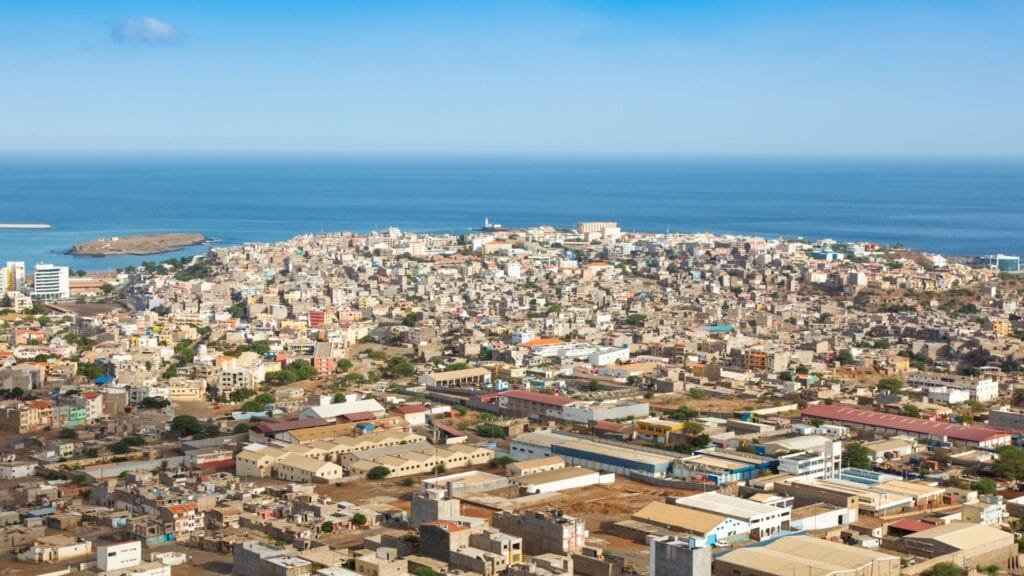
Praia, the capital of Cape Verde on the island of Santiago, is not the place you come for a postcard of white sand, and that is exactly what makes it interesting: it has a colonial centre, markets, a music scene and, a few kilometres away, the country’s first site listed as a UNESCO World Heritage Site. It can be seen in a day, is best enjoyed over two or three, and works mainly as a base for exploring Santiago.
At a glance
- Praia has been the capital of Cape Verde since 1770. It sits on the south coast of Santiago, the largest island in the archipelago, and has about 141,000 inhabitants (2021 census).
- The Plateau, the historic quarter, can be explored on foot in half a day.
- Cidade Velha, listed by UNESCO in 2009, is about 10 km away: it is the excursion not to miss.
- The climate is hot and dry for most of the year. Only August to October bring some rain.
- The city’s beaches (Quebra Canela, Prainha) are better suited to a break than to a beach holiday.
- Plan for 1 to 3 nights: one if you are continuing on to the rest of the island, three if you enjoy cities, music and day trips.
Planning a trip to Cape Verde?
Tell us about your project: we will connect you with a local agency that knows every island and will prepare a proposal tailored to your wishes and budget.

The Plateau, the historic heart
The Plateau overlooks the port and holds the city’s oldest heritage: Alexandre Albuquerque Square, the cathedral, the town hall, the presidential palace (formerly the residence of the Portuguese governor, built at the end of the 19th century), and the only pedestrian street in the centre. The district was rebuilt on a grid plan in the 19th century, which makes it easy to walk around without a map, and its historic centre has been on UNESCO’s tentative list since 2016.
We suggest walking it in the morning, before the heat, and then heading to the Ethnographic Museum, which opened in 1997. In a few rooms it explains Creole society, craftsmanship and the history of slavery, which accounts for so much about the country. To put all of this in context, our page on the history of Cape Verde and its people gives the essential background.

Sucupira, the Cabral Museum and music nights
The Sucupira market is where you really see the city at work: fruit and vegetables, clothing, instruments, street food. Go without a specific goal and with little cash on you, as at any very busy market. History enthusiasts can visit the small museum dedicated to Amílcar Cabral, a key figure in the fight for independence. Opening hours may vary, so it is best to check the day before.
In the evening, the city has a real music scene. Funaná, morna and batuque are played in bars such as Kebra Cabana, near Quebra Canela beach, which hosts live music on Fridays, and in specialist venues such as Quintal da Música. To understand what you will hear, read our page on funaná.
Praia’s beaches
Quebra Canela, south-west of the centre, is a dark-sand beach lined with a promenade and cafés. Prainha, further south, is more family-friendly and very popular at sunset. At both, the sea can be rough: ask locals or your accommodation before swimming, and do not count on constant lifeguard supervision. For a classic beach holiday, it is better to head to Sal or Boa Vista. The page what to do in Cape Verde in one week shows how to combine them.
Cidade Velha, the must-see excursion
About 10 km to the west, Cidade Velha is the oldest European colony in the tropics. Founded in 1462 as Ribeira Grande, it became a major Atlantic port and a centre of the slave trade, until the capital was moved to Praia in 1770.
On site you will see the pillory in the main square, the church of Nossa Senhora do Rosário (1495), the ruins of the cathedral begun in 1556, and Fort Real de São Filipe, built between 1587 and 1593 to defend against privateers. It stands on a plateau about 120 metres above the town, so the climb is on foot: bring good shoes. No official page publishes its opening hours or admission price. A collaborative guide consulted in November 2026 gives an approximate entry fee of 500 CVE (about €4.50), with a map and a brochure for a self-guided walk. The visit takes two to three hours and is often combined with the interior of the island.
To get there without an agency, the simplest option is the aluguer, the shared minibus, which leaves from the Sucupira market, west of the Plateau. Ask to be dropped off at the path leading up to the fort. The same guide gives about 200 CVE per person (under €2). For the return, aluguers leave the pillory square at short intervals. A taxi costs more, up to about 1,000 CVE (about €9): agree on the price before getting in. Allow half a day, including travel. Ask the local agency for a Santiago tour departing from Praia to avoid managing transport and timetables yourself.

How long to stay?
| Length of stay | Best for | Possible itinerary |
|---|---|---|
| A few hours | A stopover before another flight or island | The Plateau and the Ethnographic Museum |
| 1 to 2 nights | Travellers continuing on to Fogo or the rest of Santiago | The Plateau, Sucupira, a music evening, Cidade Velha |
| 3 nights | Lovers of cities, culture and live music | Everything above, plus a day trip into the interior of the island |
Our view: one night is enough for a stopover, but not to get a feel for the city. Staying more than three nights only makes sense if you plan day trips. For the rest of the island (Assomada, Serra Malagueta, Tarrafal), see our guide to Santiago.
When to go
Praia has a desert-type climate, dry for most of the year. Daily highs range from about 27 °C in January to 31 °C in October. Rain is rare and falls mainly from August to October, with September the wettest month (about 75 mm). For visiting the city, the most comfortable period is therefore November to July.
Several music events punctuate the year. In 2026, the Atlantic Music Expo, a world music fair, was held in Praia from 6 to 9 April, and the 32nd edition of the Gamboa Festival took place on 26, 27 and 28 June, instead of its usual May slot. Dates change from year to year, so check with the Praia city council before booking, or have the local agency schedule your stay around a festival date.
Planning a trip to Cape Verde?
Tell us about your project: we will connect you with a local agency that knows every island and will prepare a proposal tailored to your wishes and budget.
Where to stay in Praia
The Plateau suits those who want to do everything on foot. The neighbourhoods near the sea offer more calm and larger hotels, such as the Pestana Tropico or the Barceló. We have detailed the options, from apartments to hotels, in our guide to finding accommodation in Praia. If you would rather have your accommodation arranged along with the rest, the agency can include a night in Praia in a full itinerary.

Getting there, getting around and staying safe
Nelson Mandela International Airport is about 3 km north-east of the centre. A taxi is the most convenient option: expect roughly 500 CVE (about €4.50) to the Plateau, and 800 CVE (about €7) after 6 p.m., according to the same collaborative guide. A bus line serves the airport, but with very few departures. Prefer a taxi with a meter, and agree on the price before setting off if it has none.
Once in town, the Plateau is best explored on foot, and for everything else taxis are the simplest option. There are also urban bus lines. A rental car is only worth it if you want to explore Santiago at your own pace. Several rental companies operate in Praia, including Europcar, and each sets its own conditions (licence, minimum age, deposit), so read them before booking.
On safety, crime remains generally low in Cape Verde. However, Praia is a large city, and it is here, along with Sal and Boa Vista, that the risks are highest: pickpocketing, bag snatching, burglary and occasional assaults. These mostly concern night-time, isolated and poorly lit places, the staircases of the hills between neighbourhoods, and crowded markets, beaches and festivals.
In practice: during the day, keep your belongings close to you, on the Plateau as in Cidade Velha. In the evening, take a taxi rather than walking alone, avoid staircases and deserted streets, leave your passport and valuables in the accommodation’s safe, carry only a little cash, and do not resist if you are robbed. A torch helps if you go out late. For details, see our page on dangers and advice for tourists, and ask the agency to arrange evening transfers if you would rather not think about it.
Frequently asked questions
Where is Praia?
Praia is on the south coast of Santiago island, in the Sotavento group of islands. It replaced Cidade Velha as the country’s capital.
What is the main island of Cape Verde?
Santiago is the largest island in the archipelago and home to the capital. Praia alone accounts for nearly three in ten of the country’s inhabitants (2021 census).
Is Praia worth visiting?
Yes, if you enjoy culture, markets and music, and if you add Cidade Velha. If you come mainly for the beach, keep Praia for a stopover of one or two nights.
Sources
- France Diplomatie – Travel advice, Cape Verde (updated 10/09/2026) (accessed 2026-11)
- GOV.UK (FCDO) – Cape Verde travel advice (updated 28/07/2026) (accessed 2026-11)
- GOV.UK (FCDO) – Cape Verde, safety and security (accessed 2026-11)
- Government of Canada – Cabo Verde, travel advice (updated 26/05/2026) (accessed 2026-11)
- Inforpress – Gamboa Festival 2026, 26 to 28 June (27/04/2026) (accessed 2026-11)
- Inforpress – Atlantic Music Expo 2026, 6 to 9 April (07/04/2026) (accessed 2026-11)
- RTP / INE – Cabo Verde had 491,233 residents in 2021 (accessed 2026-11)
- Wikipedia – Praia (accessed 2026-11)
- Wikipedia – Cidade Velha (accessed 2026-11)
- Wikipedia – Forte Real de São Filipe (accessed 2026-11)
- Wikipedia – Museu Etnográfico da Praia (accessed 2026-11)
- Paulina on the Road – Things to do in Praia (travel experience) (accessed 2026-11)
- Cabo Verde Airports – Nelson Mandela International Airport (Praia) (accessed 2026-11)
- Wikivoyage – Praia (taxis, buses, car rental) (accessed 2026-11)
- Wikivoyage – Cidade Velha (aluguer, fort entrance) (accessed 2026-11)
Are you planning a trip to Cape Verde?
To organize your stay, we work with a local agency based in Cape Verde, which knows the archipelago island by island. Tailor-made tours, accommodation, inter-island flights, excursions: describe your project, we put you in touch and the agency prepares a proposal tailored to your wishes and budget.

Written by Adilson Gomes Garcia
Founder of Casa di CV and Gomia-Voyage, I was born in Santiago and I am committed to showcasing African territories, starting with Cape Verde. Through my platforms, I help travelers and curious minds better understand these destinations, their cultures and their realities, so they can plan authentic and respectful trips. My goal: to offer a clear, local and useful perspective for discovering Africa as it really is, with its riches and its identity.