 Français
 Español
 Italiano
 Deutsch
 Português
 Русский
 Nederlands
 English
Contents
The currency of Cape Verde is the Cape Verdean escudo (code CVE), and its rate against the euro is fixed: 1 € is worth 110.265 CVE, whatever the day. No nasty surprises on that front. What takes a bit of planning is knowing when euros are enough, when you need escudos, and where to get them.
At a glance
- Official currency: the Cape Verdean escudo (CVE), 1 € = 110.265 CVE, fixed parity with the euro.
- The euro is widely accepted, especially on Sal and Boa Vista; elsewhere, escudos are more practical.
- Visa and Mastercard cards generally work, for payments and withdrawals, on the Vinti4 network. Fees depend on your bank, not on Cape Verde.
- To exchange money, use a bank or an authorised exchange office: buying foreign currency elsewhere is a currency offence.
- You can leave with 20,000 CVE (about €181) in notes and coins; above that, authorisation from the Banco de Cabo Verde is required.
- Travellers’ cheques are not commonly accepted.
Planning a trip to Cape Verde?
Tell us about your project: we will connect you with a local agency that knows every island and will prepare a proposal tailored to your wishes and budget.
The escudo in practice: notes, coins and rough amounts
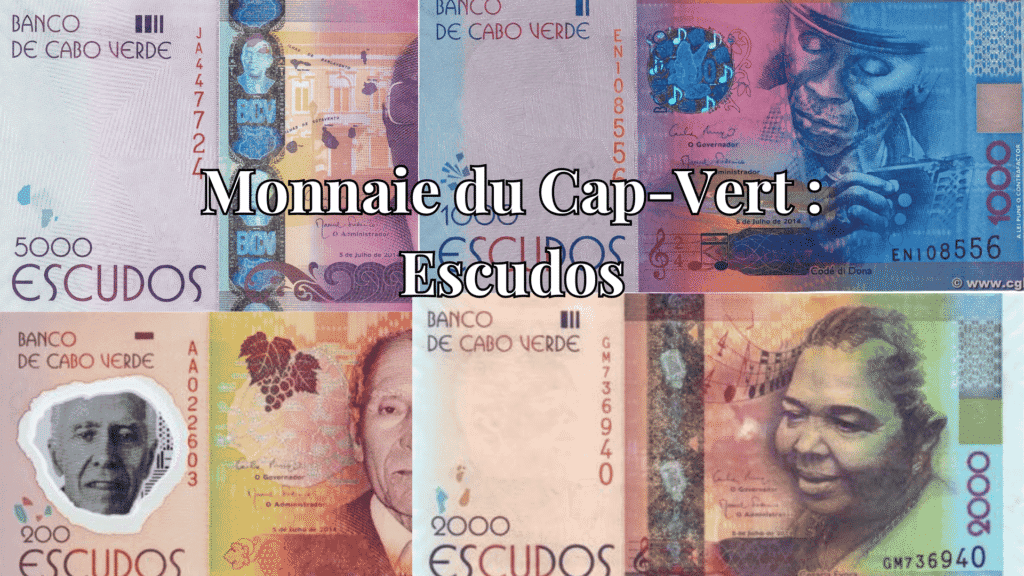
Notes in circulation are 200, 500, 1,000, 2,000 and 5,000 escudos, and common coins range from 1 to 100 escudos. The central bank has also issued commemorative coins of 200 and 250 escudos. To get your bearings, keep in mind that one euro is a little over 110 escudos, or about €9 for 1,000 CVE. A small village shop will often struggle to give change on a 5,000 CVE note: stick to the 200 to 1,000 denominations for everyday use.

| Amount in CVE | Equivalent in euros |
|---|---|
| 200 CVE | €1.81 |
| 500 CVE | €4.53 |
| 1,000 CVE | €9.07 |
| 2,000 CVE | €18.14 |
| 5,000 CVE | €45.35 |
| 20,000 CVE | €181.38 |
And in the other direction, here is what your euros become once exchanged, before commissions.
| Amount in euros | Equivalent in CVE |
|---|---|
| €10 | 1,103 CVE |
| €20 | 2,205 CVE |
| €50 | 5,513 CVE |
| €100 | 11,027 CVE |
| €500 | 55,133 CVE |
These rounded equivalences do not move, since the parity is fixed. Institutions do add their own commissions, however: the rate stays the same, but the fee varies.

Paying in euros or in escudos?
The euro is accepted without difficulty in hotels, agencies and many restaurants on Sal and Boa Vista, the two islands most geared towards beach holidays. Elsewhere, on Santiago, Santo Antão, São Vicente, Fogo or São Nicolau, it is better to count in escudos for shared taxis, markets, small restaurants and local excursions. Paying in euros remains possible in some places, but the price and the rate applied are then set by the merchant, which is not always in your favour. As for the dollar and other currencies, leave them at home. To find out which stages of your itinerary are paid in euros and which in escudos, describe your project to the local agency.
If your trip covers several islands, withdraw escudos on arrival rather than relying on a counter later on. To choose those islands, our guide Cape Verde: which island to choose based on your expectations helps you build the itinerary, and the Cape Verde map shows where the main towns are.

Bank cards and ATMs
The Vinti4 network generally accepts Visa and Mastercard cards, for payments as well as withdrawals. Foreign cards are in common use: in the first quarter of 2025, they generated 8.3 billion escudos in transactions (about €75 million), and roughly two thirds of those operations were payments to merchants, the rest cash withdrawals. In other words, the card has become a normal way for visitors to pay, especially in towns and tourist areas, although cash remains useful elsewhere.
Withdrawal and exchange fees are set by your card issuer: before leaving, ask your bank for the commission on a withdrawal outside the euro zone and your weekly withdrawal limit.
On the ground, two realities call for a little organisation: power cuts, which are regular, can disrupt banking operations, and theft is common. So withdraw reasonable sums rather than large wads of cash, and keep a little cash in hand as a buffer. If you are spending a few days on a more remote island, plan what you need from the main town before you go. And for a multi-island circuit, ask the local agency for a detailed quote: you will know what is paid in advance and what you will pay on site.
Where to exchange your euros
Banks and authorised exchange offices, found at airports and in the main towns, are the only places to use. This is not just a matter of caution: buying foreign currency from unauthorised entities is a currency offence, punishable by a fine of 10% to 100% of the amount, with funds potentially seized. In practice, refuse any currency exchange offer in the street, even if the rate seems fair.
On entering the country, currency exceeding the equivalent of 1,000,000 CVE (about €9,070) must be declared to the border police, a threshold the vast majority of travellers will never reach. If you are unsure how much to budget for a specific itinerary, ask the on-site team before booking.
Before you leave: what to do with your escudos
You may leave the country with a maximum of 20,000 CVE in notes and coins, per person and per trip; above that, prior authorisation from the Banco de Cabo Verde is required, with supporting documents.

The simplest approach is to spend your surplus before leaving and, towards the end, withdraw only what you need. If you still have too many escudos, return to a bank or authorised exchange office before your flight: anyone may ask there to buy foreign currency for a trip, up to 1,000,000 CVE. Do not wait until you are home, because we found no published rule guaranteeing that a counter will take back escudos abroad. Also keep the receipts for your exchange transactions, useful if you leave the country with large sums.
To finish preparing your trip, you can read the guide on organising your trip to Cape Verde, the page on entry formalities, and the one on airports and flights.
Frequently asked questions
What is the currency of Cape Verde?
It is the Cape Verdean escudo (CVE), issued by the Banco de Cabo Verde.
Can you use euros in Cape Verde?
Yes, especially on Sal and Boa Vista. Elsewhere, keep escudos for everyday spending.
Sources
- Cabo Verde Airports: limits on the circulation of money (purchase of foreign currency, export of escudos, fines) (accessed 2026-10)
- Cabo Verde Airports: passenger guide (accessed 2026-10)
- Banco de Cabo Verde: exchange rate statistics (method, ECB reference rates, monthly series) (accessed 2026-10)
- Banco de Cabo Verde: exchange statistics, EUR 110.26500 buying and selling (accessed 2026-10)
- Banco de Cabo Verde: banknotes and coins, frequently asked questions (accessed 2026-10)
- Banco de Cabo Verde: banknotes in circulation (accessed 2026-10)
- Banco de Cabo Verde: coins in circulation (accessed 2026-10)
- Banco de Cabo Verde: legislation on currency exchange operations (accessed 2026-10)
- SISP: Vinti4, payment network and ATMs on all islands (accessed 2026-10)
- International Trade Administration: Cabo Verde Country Commercial Guide, business travel (published 31/07/2022) (accessed 2026-10)
- Government of Canada: travel advice, Cabo Verde (updated 26/05/2026) (accessed 2026-10)
- Forbes Africa Lusófona: international cards in Cape Verde, Q1 2025 (BCV data, 15/07/2025) (accessed 2026-10)
Not keen on handling money on site?
With the local agency, accommodation, transfers and excursions are booked before you leave. Free enquiry, no obligation.

Written by Adilson Gomes Garcia
Founder of Casa di CV and Gomia-Voyage, I was born in Santiago and I am committed to showcasing African territories, starting with Cape Verde. Through my platforms, I help travelers and curious minds better understand these destinations, their cultures and their realities, so they can plan authentic and respectful trips. My goal: to offer a clear, local and useful perspective for discovering Africa as it really is, with its riches and its identity.